
An oil painting on panel, *Still Life with Peaches and Grapes* by Henri LEROLLE
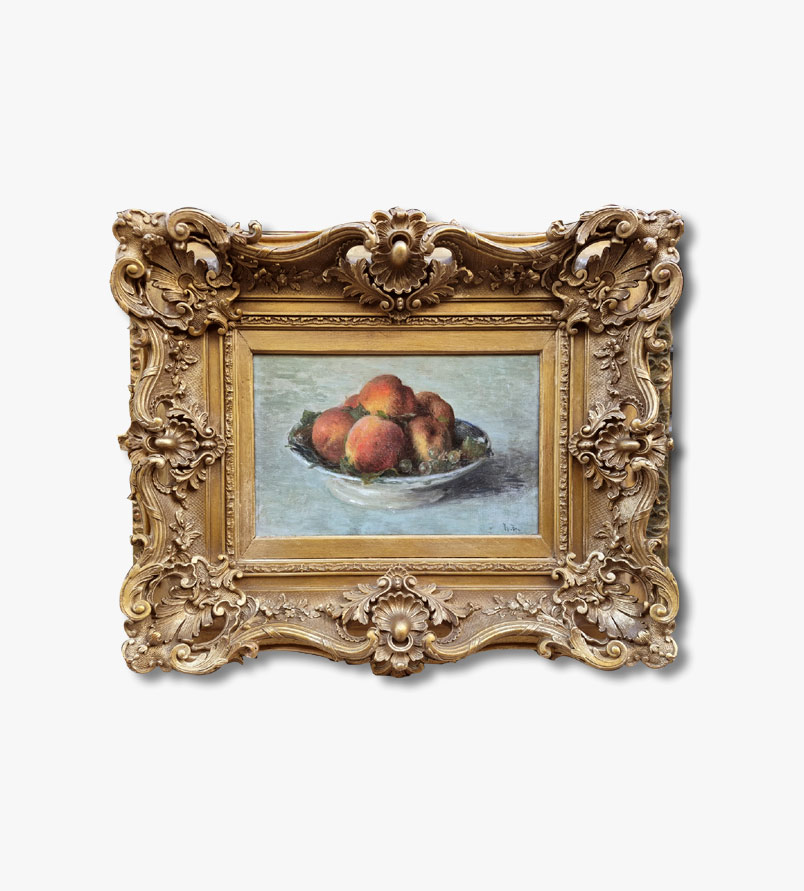
An oil painting on panel, *Still Life with Peaches and Grapes* by Henri LEROLLE
Prix sur demande / prices on request
Henry LEROLLE 1848–1929
Maurice Denis, a friend of Henry Lerolle’s, wrote, “He is both a painter and a musician, constantly drawn to the new experiments of his time.”
In his studio, Lerolle hosted Degas, and Fantin-Latour painted a portrait of his wife. At his home, composers Debussy and Chausson would come to play the piano while discussing poetry and literature with Mallarmé, Claudel, and André Gide.
Henry Lerolle was a true Parisian; he was born on the Place des Vosges in 1848.
His father was a bronze sculptor and landscape painter, and his mother—the daughter of an engineer who ran a heating system business (the first heating appliances)—made them part of the new bourgeoisie in a French economy booming with the country’s industrialization.
Maurice Denis, again, summed him up this way: “There was something of the upper-class bourgeois and the Parisian street urchin in him.”
Henry, like his brother Paul, was raised in an artistic environment where music played a major role.
Henry took up the violin at a very early age, an instrument he would play throughout his life. They received a very religious upbringing and traveled regularly with their parents to Switzerland, Italy, and Marseille, as well as to Houlgate, to their grandfather’s house, where Henry would go to paint outdoors with Berthe Morisot.
At the age of 16, Henry Lerolle joined the studio of Louis Lamothe, a great classical painter with Ingres-inspired tendencies. He then attended the Académie Suisse—named after its founder (a former model for David named Martin François Suisse)—on the Île de la Cité, a place with no formal instruction where absolute freedom reigned, and which was frequented by Corot, Monet, and Manet.
At the same time, he roamed the halls of the Louvre and, to perfect his technique—following in the footsteps of the great masters before him—he copied Poussin and Veronese and admired the works of Flandrin and Puvis de Chavannes there.
Further information
| Dimensions | 56 × 50 cm |
|---|
Henry exhibited his first painting at the Salon in 1868.
Lerolle’s early works were primarily religious in nature, as Maurice Denis noted. In 1874, one of his paintings on a biblical theme received widespread acclaim and was purchased by the government. He would submit several more in the following years. In 1879, *Jacob at Laban’s* was awarded a third-class medal.
Yet it was with a masterful composition (2.65 × 4.14 m), titled *In the Countryside*, in which Lerolle depicts a young shepherdess strolling among the trees with her sheep, that he won the First-Class Medal at the 1880 Salon.
This work is so pure that no fewer than nine different artists set out to copy it. Only Millet’s *The Angelus* had, before it, sparked such enthusiasm.
From that moment on, Lerolle would devote many of his paintings to the rural world—soothing, powerful, and timeless compositions.
Beginning in the 1890s, in the privacy of his home and studio, he began to create more intimate compositions—still lifes, some in the style of Fantin-Latour, whose works he collected—as well as genre scenes and portraits of his wife and daughters.
He also carries out official commissions for decorative work at the Sorbonne, Paris City Hall, in Dijon, in Caen, and elsewhere…
Still life is not the genre that brought Henry Lerolle success, but it is the genre that speaks to the intimate.
Still life has always been a prominent feature in art, especially in the Flemish schools, which elevated it to spectacular heights.
In France, it was Chardin, in the 18th century, who brought the genre to prominence.
In the 19th century, it was particularly Fantin-Latour (1836–1904), with his classical and timeless virtuosity.
Henry Lerolle, as we know, is a great collector.
In his home, paintings by his contemporaries adorn the walls: Degas, Puvis de Chavannes, Renoir, and a certain Fantin-Latour!
It is hard not to see a connection between our painting and the poetic, luminous, and gentle compositions of the artist who is already considered a master.
In fact, Fantin-Latour painted a portrait of Madame Lerolle in 1882 (now in the Cleveland Museum of Art).
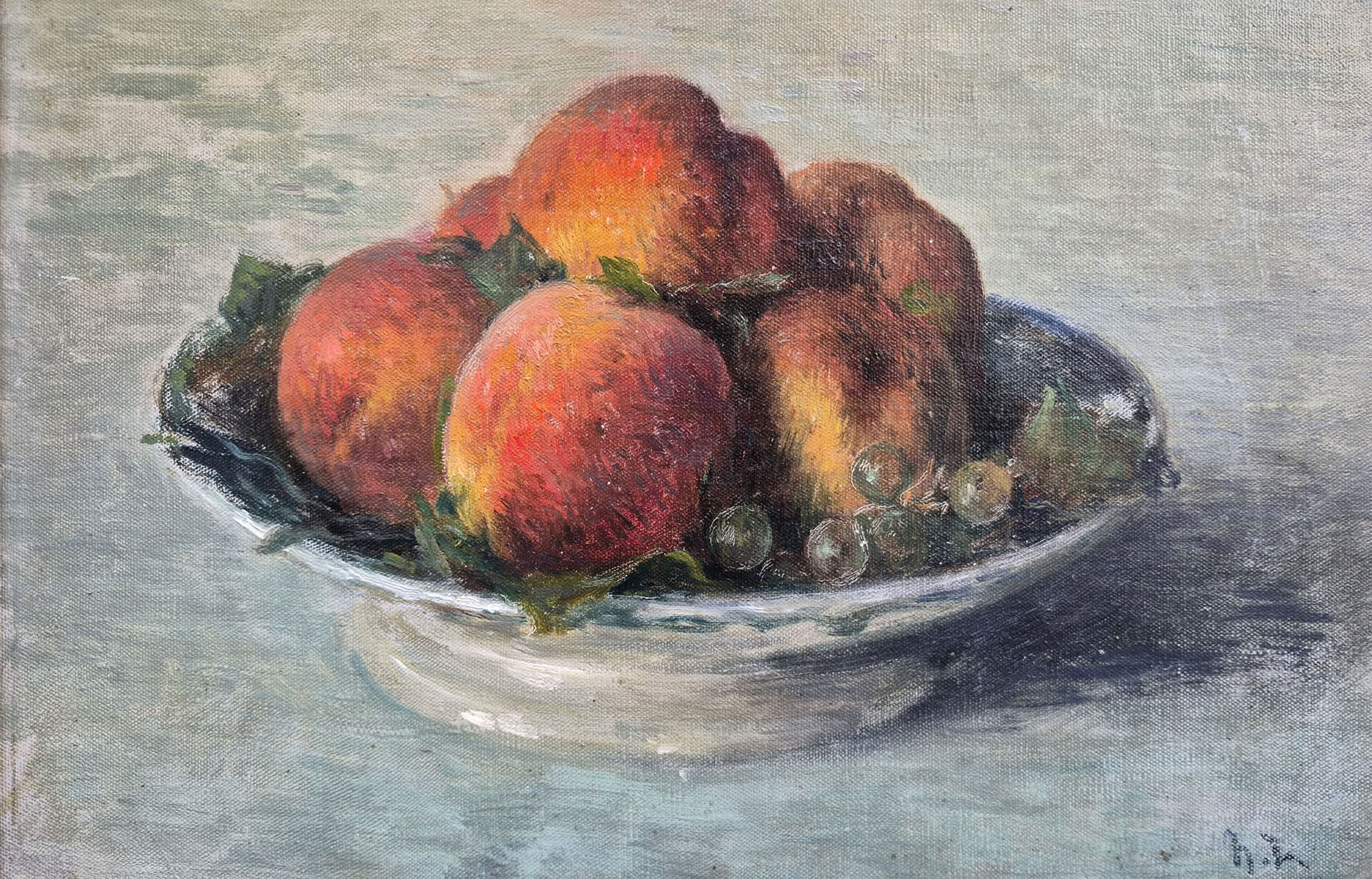
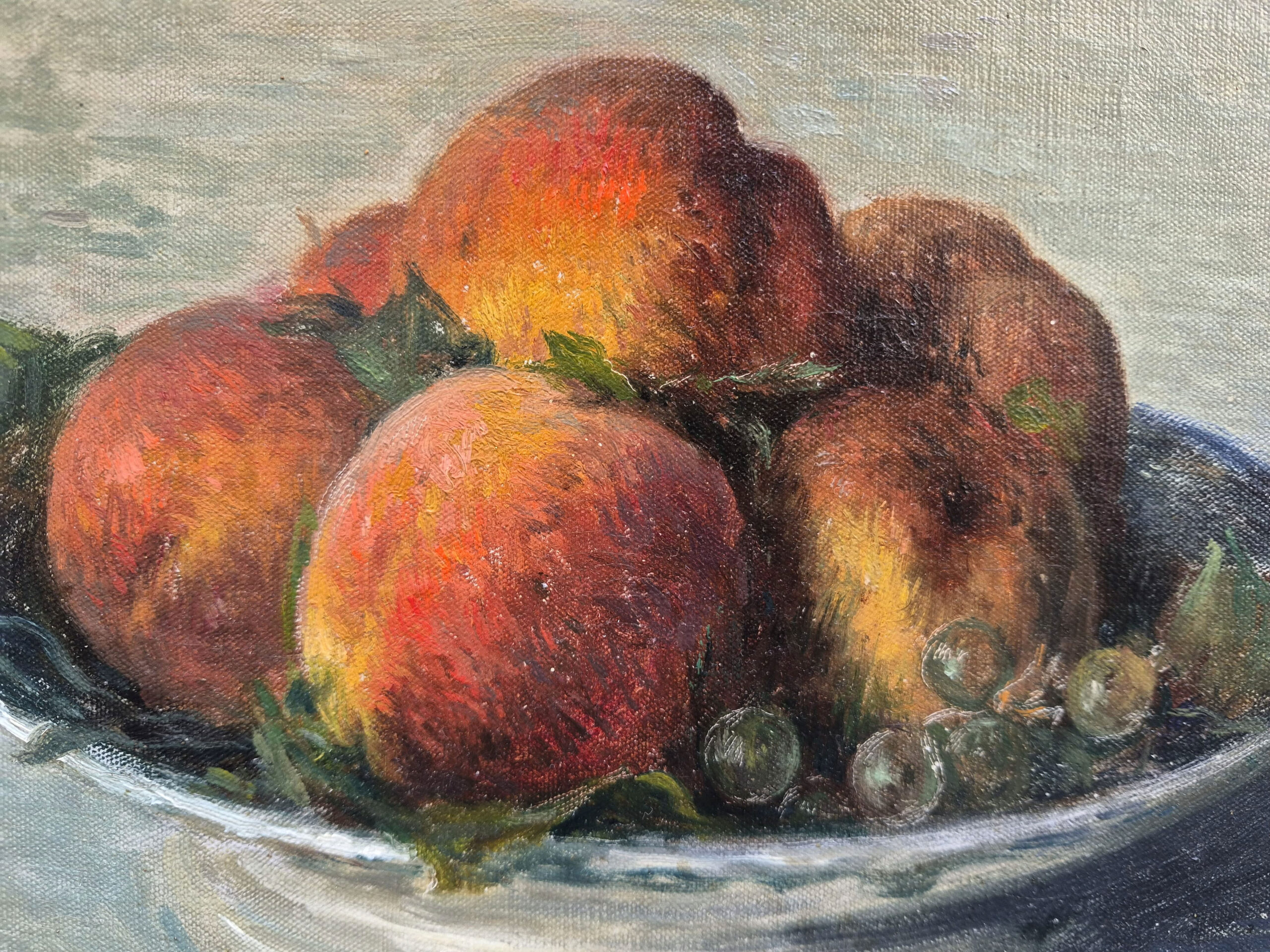
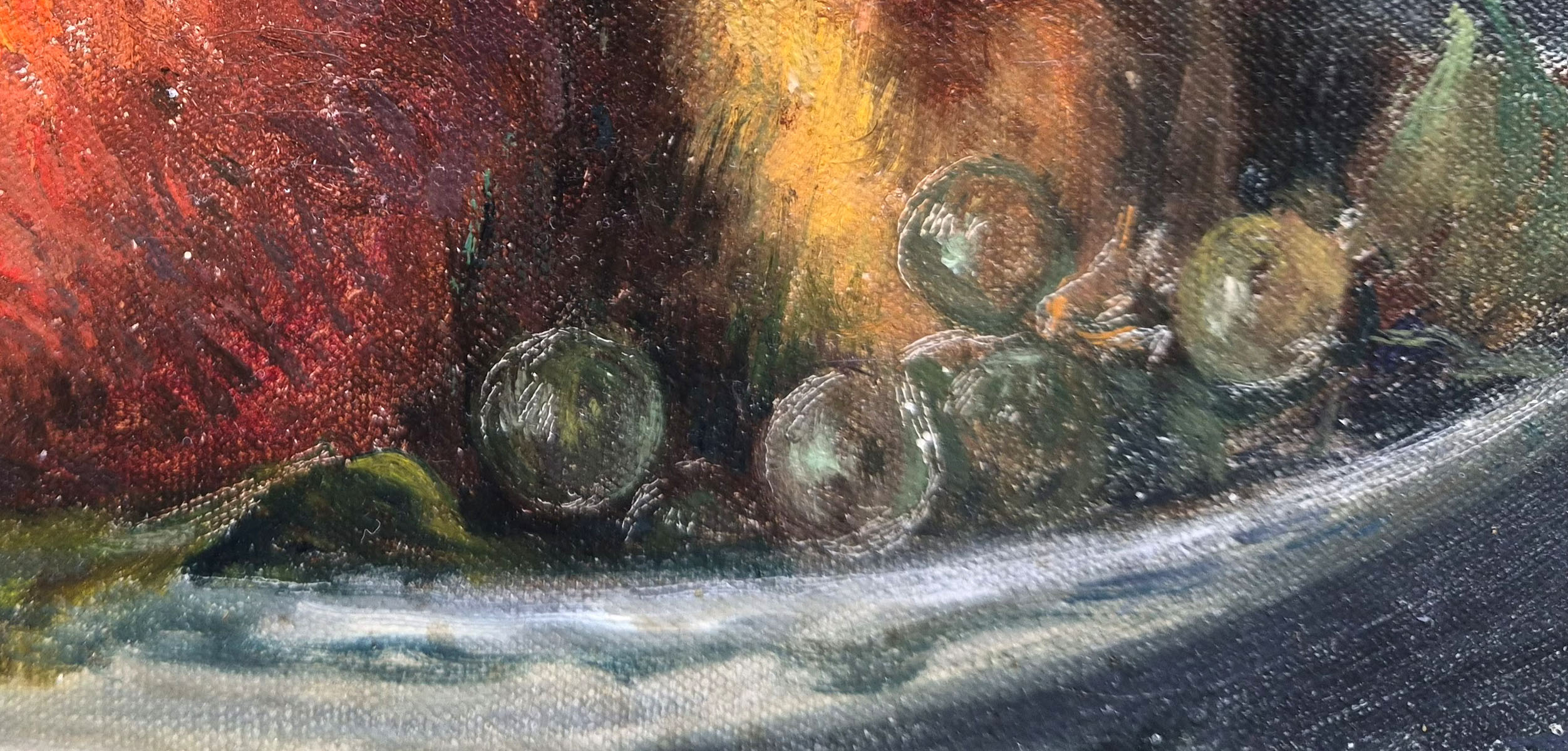
Arranged as if on a tablecloth, painted in shades of gray, and presented in a white porcelain bowl, the composition of the fruit, the orange-pink color palette, the velvety texture, the translucency of the grapes, and the close-up framing immediately bring to mind Fantin-Latour.
However, whereas Fantin-Latour generally favors rather dark backgrounds for his still lifes featuring peaches, Lerolle illuminates the painting with this white tablecloth. The peaches seem enveloped in this gray and white halo.
Fantin-Latour excels in the classical rigor of composition and brushwork, with tremendous chromatic power.
On this last point, the two artists are in agreement.
But Lerolle breaks free from classicism and its demands.
The peaches are built up with small touches of very pure red, orange, and brown—almost like strokes at times.
The bowl is almost sketched in places.
With Lerolle, the forms become more fluid; the fruits seem more alive, and their texture more realistic, less idealized.
Was this influenced by his Impressionist friends?