
An oil painting on cardboard, *Nude with Flowers* by Joseph LAMBERTON
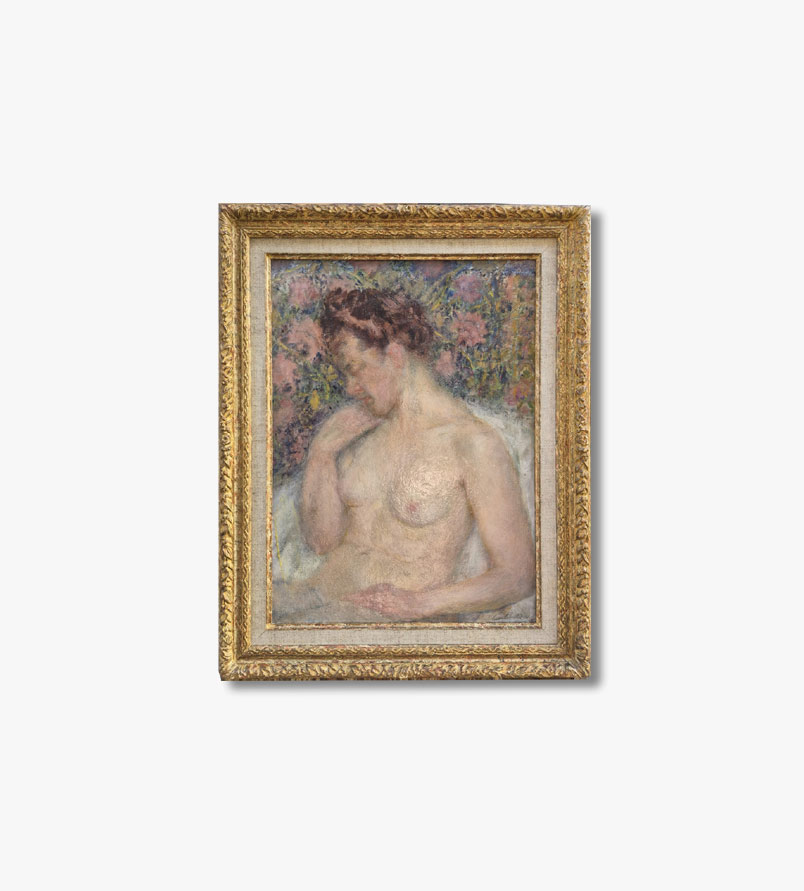
An oil painting on cardboard, *Nude with Flowers* by Joseph LAMBERTON
Prix sur demande / prices on request
Joseph Lameberton 1867–1943
The son of a metal engraver in Saint-Étienne, a city whose industrial activity is based primarily on metallurgy, arms manufacturing, and ribbon production.
In Saint-Étienne, the industrial arts are closely linked to drawing, printmaking, and decorative sculpture.
From 1883to 1887, Lamberton studied at the Regional School of Industrial Arts in Saint-Étienne.
In 1888, he moved to Paris to study at the School of Decorative Arts, in the sculpture department.
In 1892, he joined the studio of Alexandre Falguière (1831–1900), one of the most renowned French sculptors of his time, whose work was characterized by a particular interest in anatomy, the depiction of movement, and the sensuality of forms.
At the same time, he attended the Académie Julian from 1895 to 1896 to take painting classes and worked with Jean-Paul Laurens and Benjamin-Constant.
Further information
| Dimensions | 50 × 64 cm |
|---|
In Saint-Étienne, Lamberton is known first and foremost as a sculptor.
He contributed to the decoration of several apartment buildings and public structures, particularly as part of the city’s architectural development in the early 20th century.
He collaborated with the architect Noulin-Lespès and created facade decorations in a style reminiscent of Art Nouveau.
Alongside his sculptural commissions, Lamberton continued his work as a painter and exhibited at national and regional art salons.
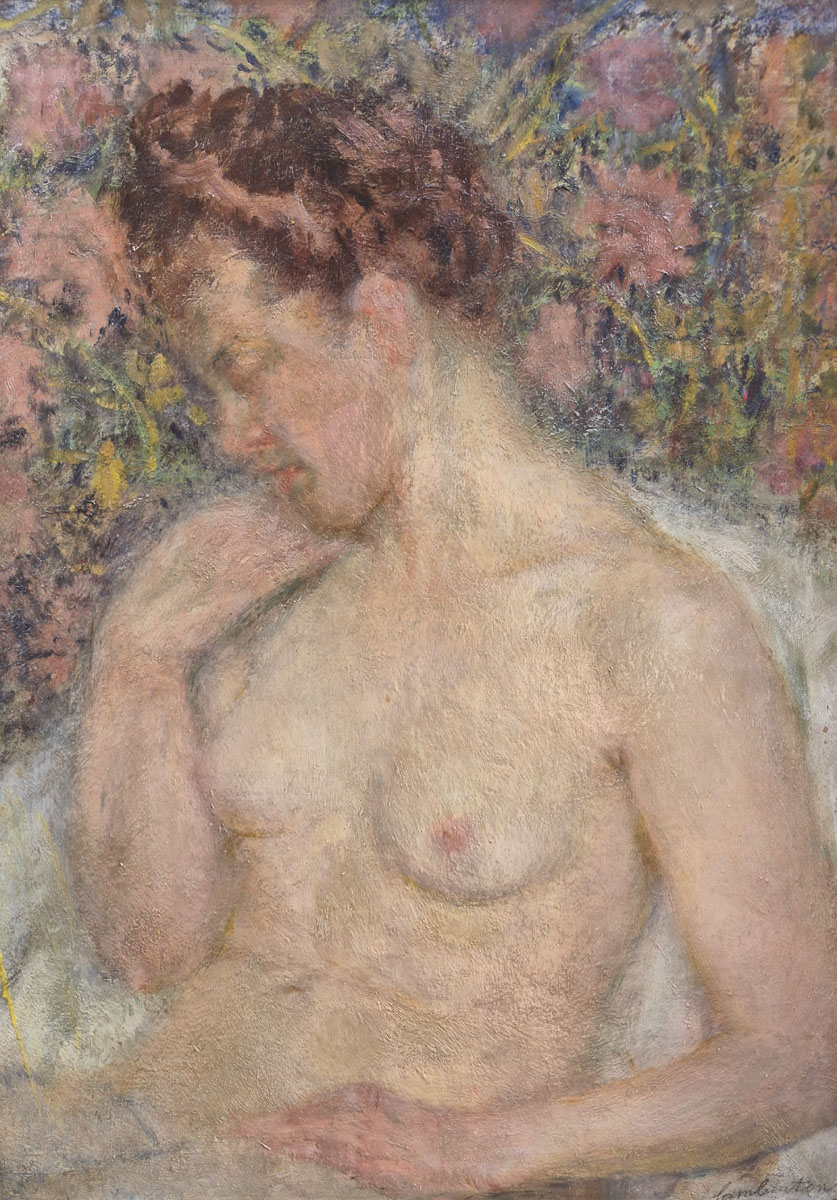
Our painting depicts a young nude woman, shown from the waist up, in a meditative pose.
The composition of the painting is based on a subtle interplay of curved lines.
Her tilted head, the line of her shoulders, and her folded arms create a fluid movement that naturally draws the viewer’s gaze toward her face.
The body occupies almost the entire pictorial surface.
This very close framing reinforces the model’s presence and gives the composition an almost sculptural quality.
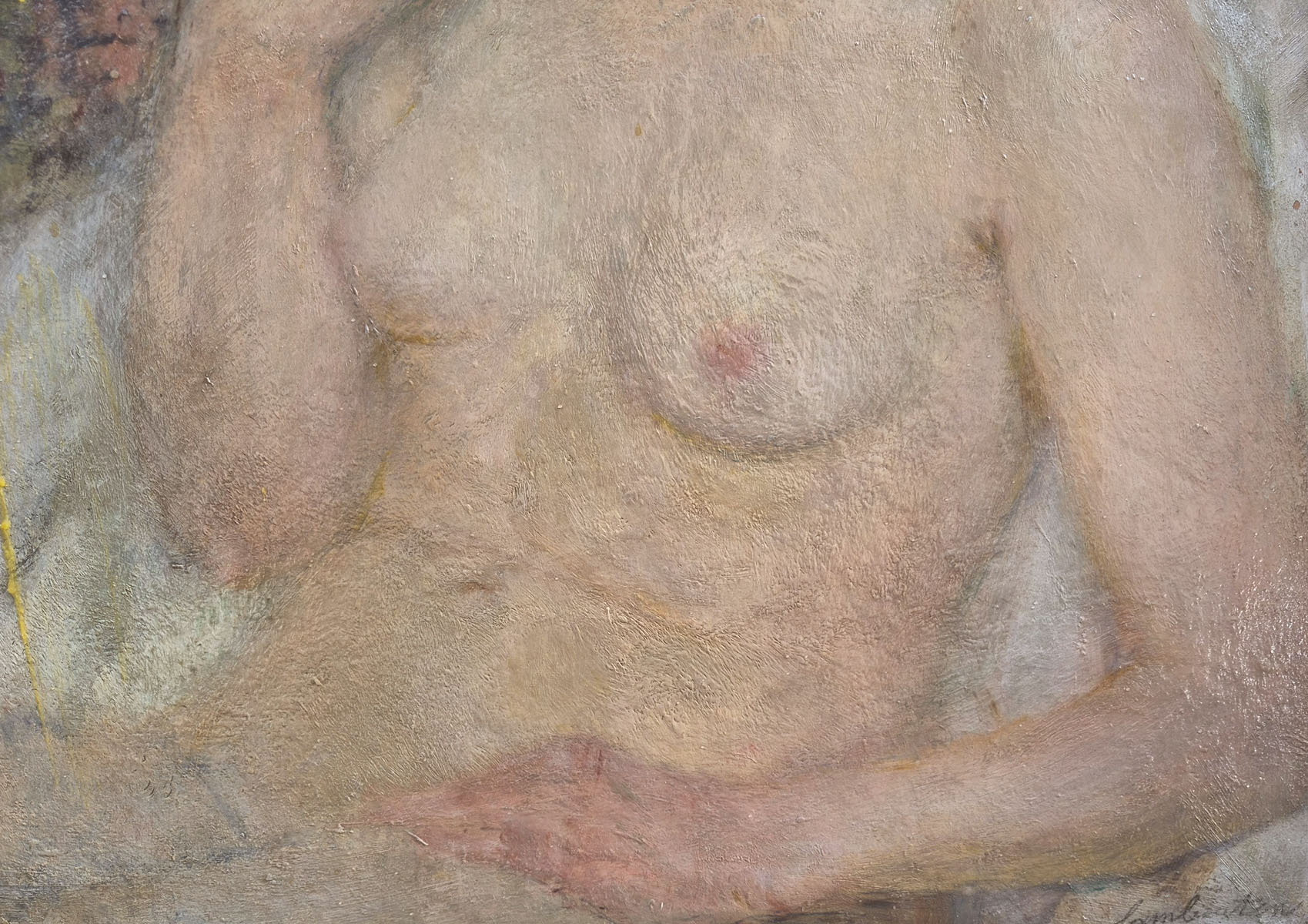
The raised arm, the curve of the shoulder, and the contours of the torso attest to the attention paid to anatomy.
However, Lamberton does not seek to define the contours with rigid lines.
On the contrary, the forms seem to gradually blend into the colorful atmosphere surrounding them.
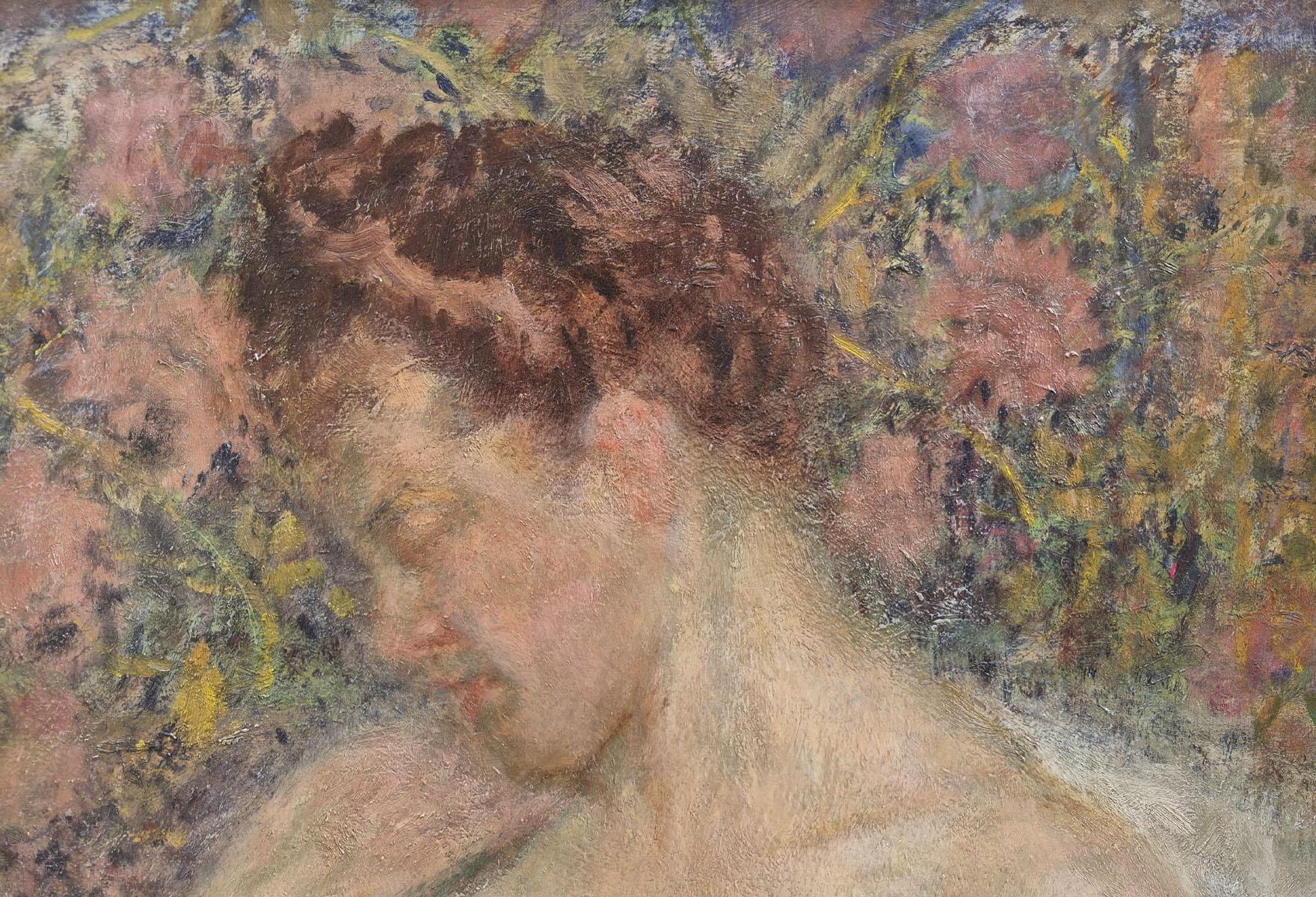
Behind the young woman, vegetation in shades of pink, green, yellow, and purple spreads out.
The painter uses a particularly delicate color palette.
The pinks and ochres of the skin are interspersed with green and purplish hues.
The face is rendered in richer tones, while the chest and shoulders are bathed in diffused light.
The contours are sometimes deliberately blurred.
This approach is reminiscent of some of Renoir’s experiments with the fusion of flesh tones and the atmosphere.