
An oil on canvas, Tribute to Pablo Casals by Pierre ABROGIANI
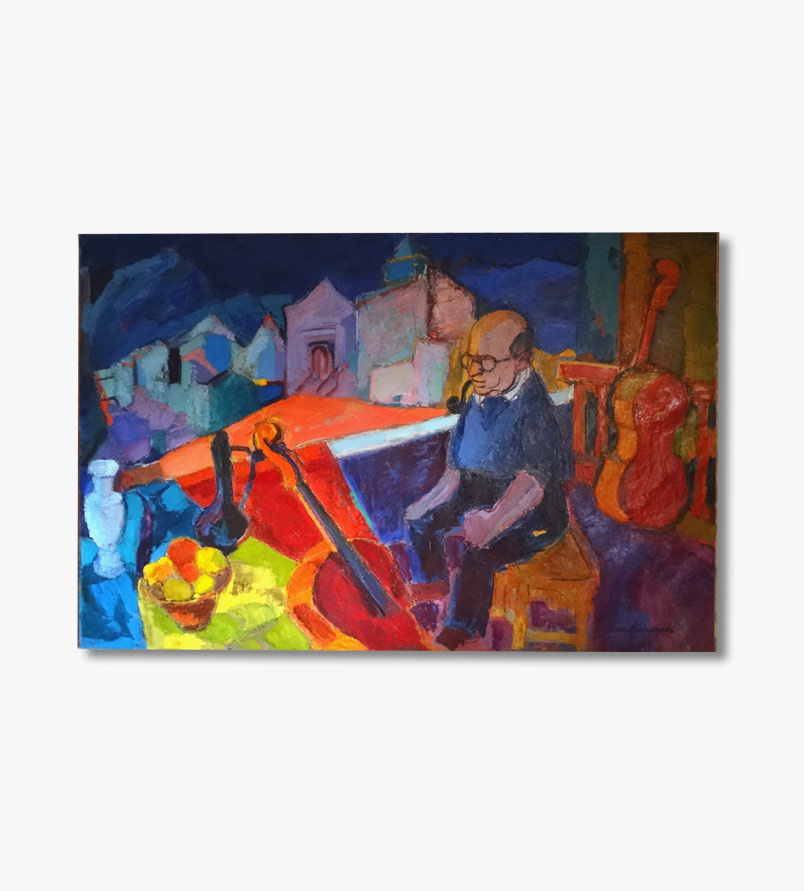
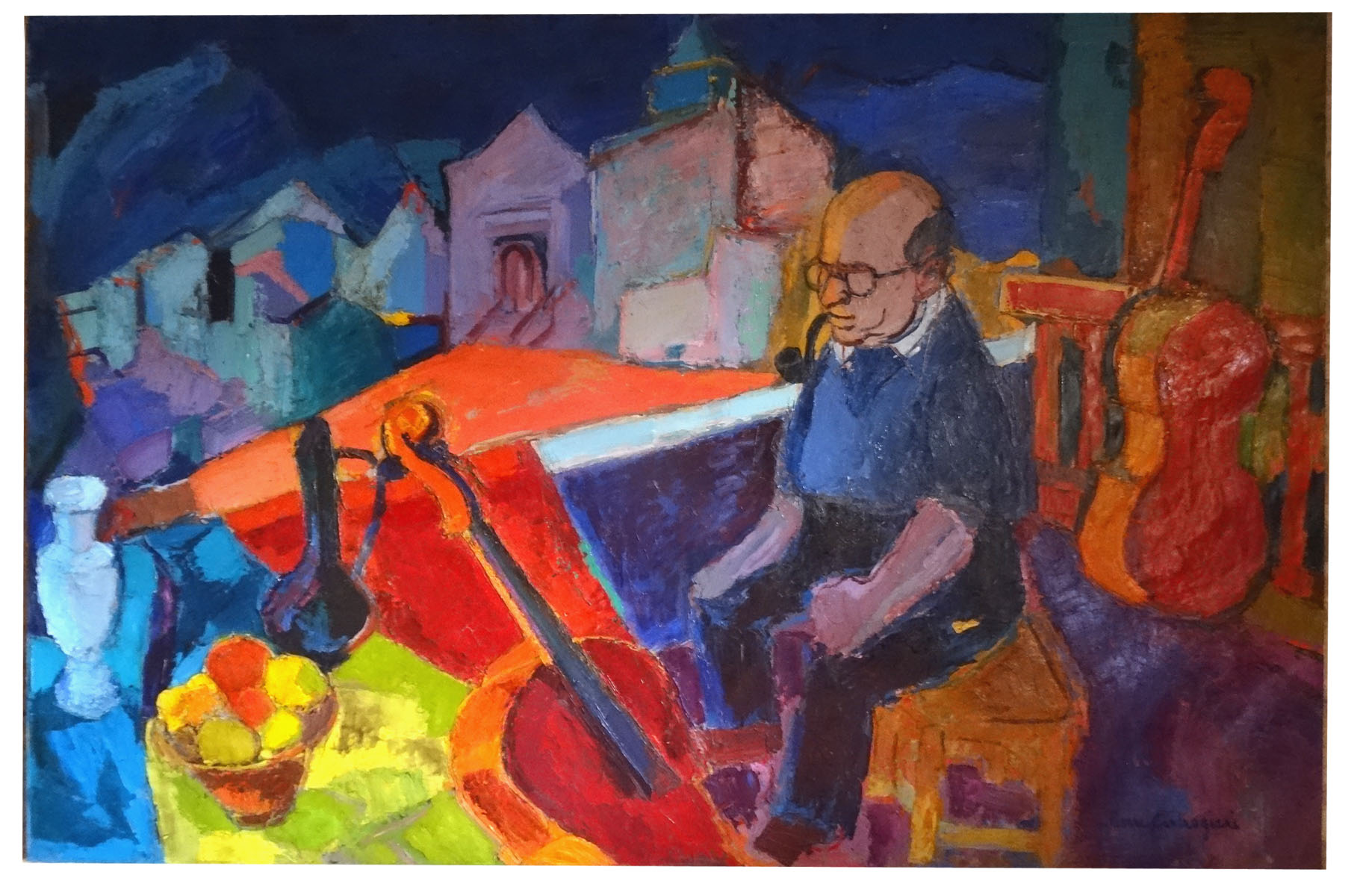
An oil on canvas, Tribute to Pablo Casals by Pierre ABROGIANI
Prix sur demande / prices on request
Pierre AMBROGIANI
Important canvas - 197 x 295 cm
Tribute to Pablo CASALS - 1955
Exhibitions: - Peintres témoins de leur temps 1956 - Rehabilitation of the Portrait
- Musée de Toulon 1958 rep. cat. no. 2
- V. Charity rep. cat. no. 32
Bibliog. P. Ambrogiani by A. Alanzen, ed. Tacussel
Pierre Ambrogiani
One of the great Provençal masters of the modern period.
Originally from Ajaccio, he is associated with the Expressionist movement.
Born into a modest family, he moved to Marseille in 1908. His interest in drawing and modeling began at an early age.
As a child, he made little figurines such as santons and others. At the age of 12, he became a "little telegrapher". He then exhibited his santons at one of the Marseilles post office crib exhibitions. In 1923, at the age of 16, the painter Auzias, seduced by his colorful figurines, offered him a place on the sidelines of his exhibition at the Langlois silversmith's shop.
While working as a letter carrier, Ambrogiani continued to exhibit his work. He was noticed by André Malraux and Louis Aragon, who befriended him and supported his artistic career. In 1936, for example, he founded the first Maison de la Culture in the French provinces, where he exhibited work by his Marseilles painter friends Antoine Serra, Louis Toncini and François Diana.
In Marseille, Ambrogiani also rubbed shoulders with Marcel Pagnol and Jean Giono.
He devoted himself entirely to his career as an artist in 1937, participating in the Salon d'Automne and becoming a member.
He took part in numerous group exhibitions of contemporary French art in France and abroad, including Paris, Marseille, Toulouse, New York, London and Turin.
A plein-air painter, his genius is distinguished by his fiery, tawny-colored canvases.
He liked to paint landscapes of the South of France, which he treated with thick, oily matter.
Ambrogiani reveals a modern Provence, where shapes dissolve in color. Moving more and more towards the stripping away of structure and drawing, the artist approached a deliberately figurative abstraction. Our work is representative of this period.
Further information
| Dimensions | 295 × 197 cm |
|---|
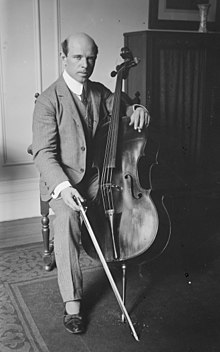
Pablo Casals
With the lyricism of a fiery colorist, he translates everything illuminated by the sun of Provence, which found in him its popular master. Marcel Pagnol said of him: "..., it is not ridiculous to pronounce the name of Cézanne".
Pablo Casals is one of the musicians of the 20th century who has most inspired artists. Jan Toorop, Raoul Dufy, Oskar Kokoschka....were all fascinated by the cellist's aura.
From an early age, he played a variety of instruments, but it wasn't until he entered the Barcelona Conservatory in 1888 that he fell under the spell of the cello. His talent began to be recognized as early as 1899, leading to performances for Queen Victoria, and later for Queen Elisabeth of Belgium and the Kennedy family...
He then committed himself to the cause of republic and freedom, against dictatorships, in particular that of Franco in Spain, for which he refused to play. He was the first to take a stand and use his talent to defend freedom of expression.
Encounter and work
In 1955, Ambrogiani met Casals at the home of their mutual friend, the engraver Louis Jou.
The cellist played Bach while Jou chiselled. While they took a break and chatted, Ambrogiani sketched Casals on the spot.... Thus was born our painting.
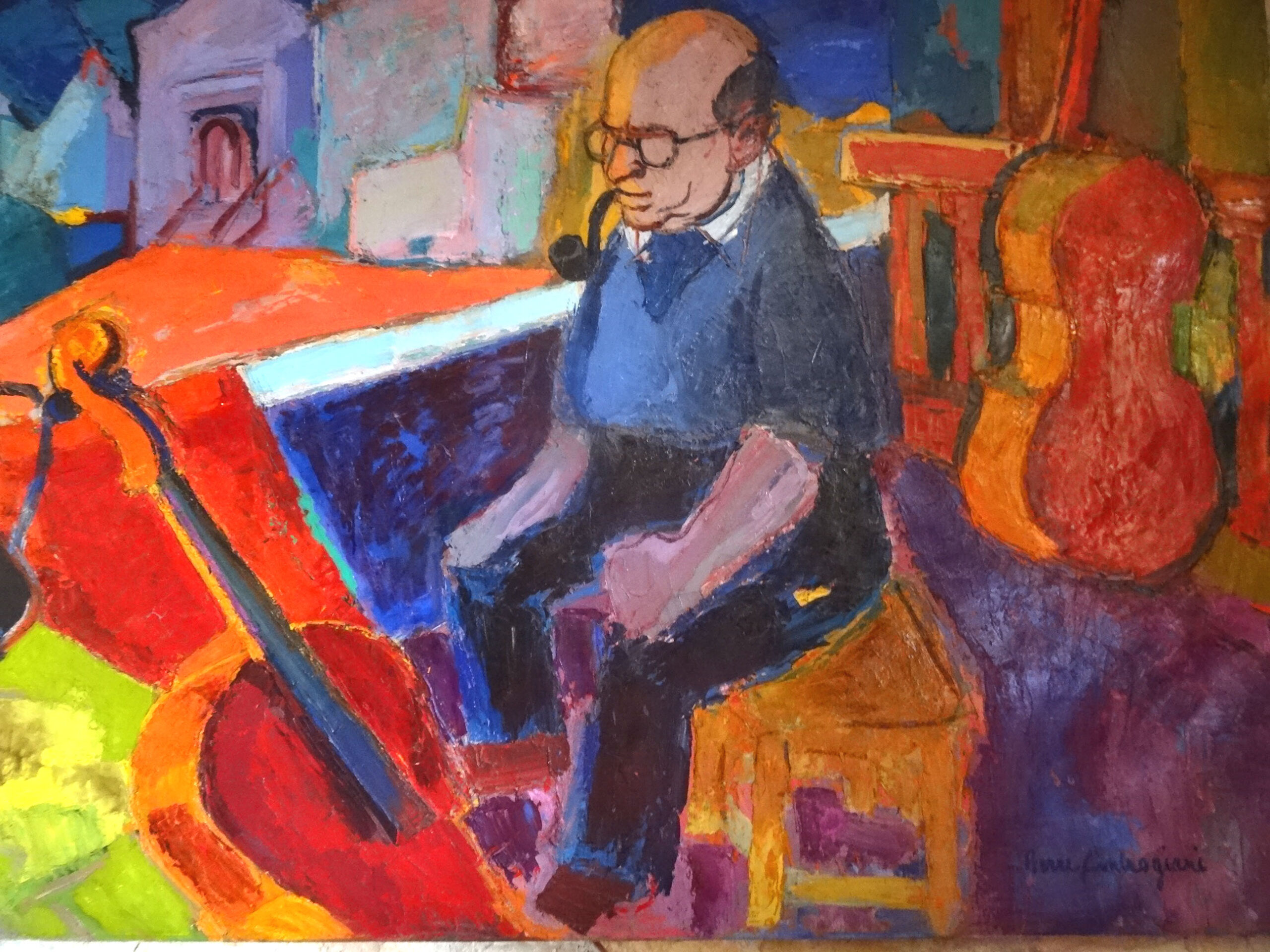
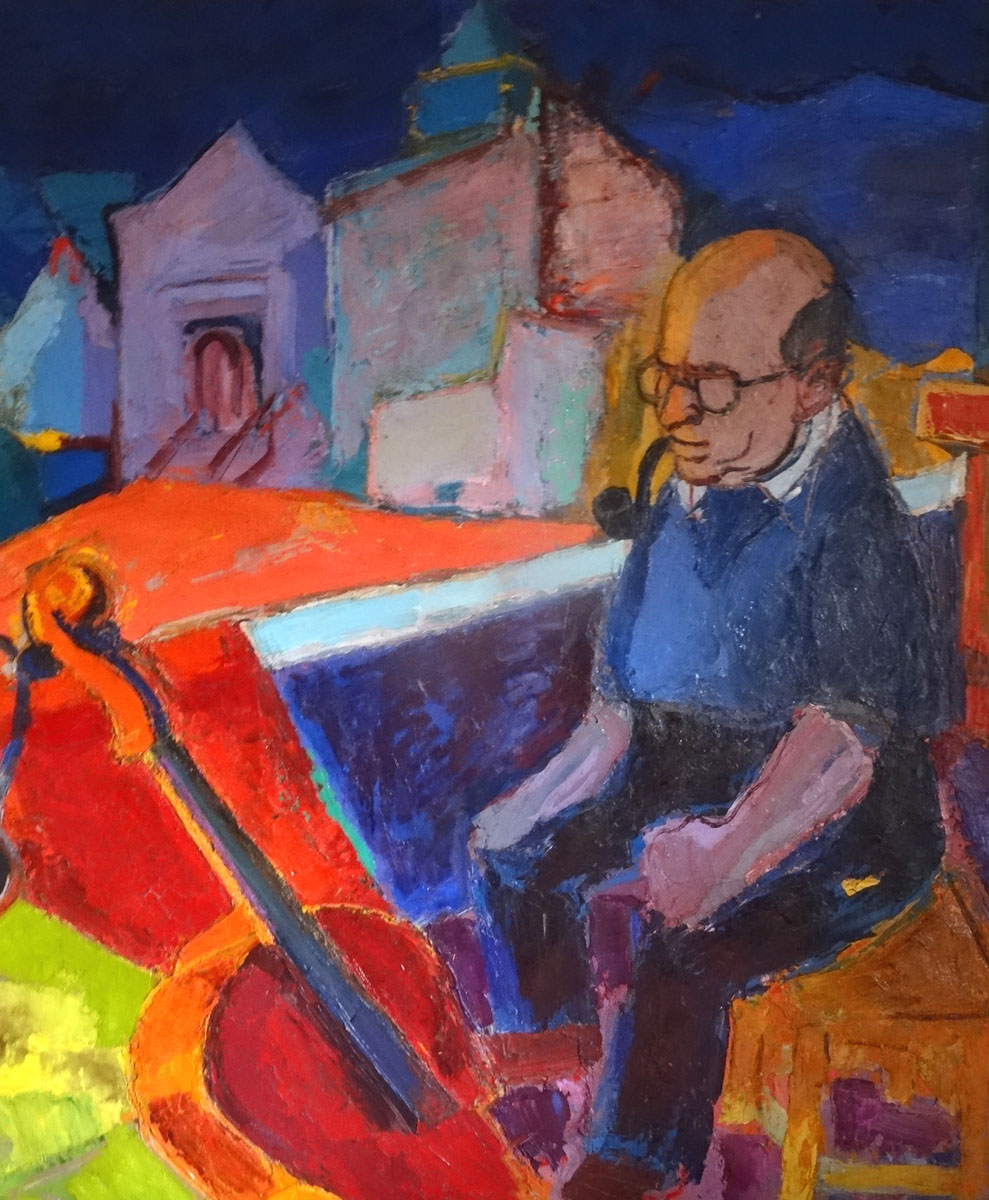
On the finished canvas, Pablo Casals, seated and smoking his pipe, pauses meditatively between the two instruments.
Behind, the church of Les Baux de Provence (the painter's sacred region) appears in a rocky landscape. The table is set with jug, gargoyle and fruit.
It's probably with this tribute to Casals in mind that Ambrogiani says: "I've done sonorous portraits, with very strong tones. I quickly lose the drawing because I overflow. I don't stop the line. I try to paint not the outline, but what's under the skin, the bone of the character".
A year later, at the Salon "Peintres Témoins de leur Temps" at the Musée Galliera, our work entitled "Hommage a Pablo Casals" was unanimously acclaimed by international critics, ... the presence of the model added to the prestige of the painting.
For his friend Jean Giono, he succeeded in painting "the portrait of a character by portraying a landscape". Indeed, Pablo Casals is at one with his subject matter, an arrangement of broad, vivid flat tints. His palette of blue, lilac, sulfur, green and orange echoes the colors cited in 1888 by Vincent Van Gogh, of whom he was a great admirer.