
A gouache, London by Gaston PRUNIER
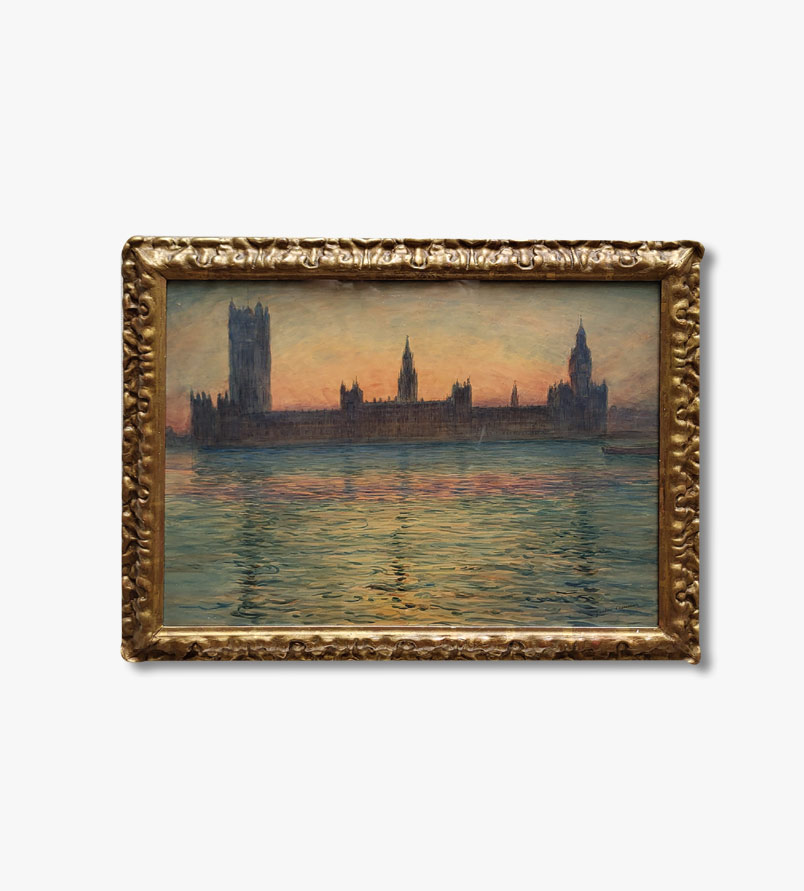

A gouache, London by Gaston PRUNIER
2.800,00 €
Gaston PRUNIER (1863–1927)
Mixed media: gouache and pencils
French painter, watercolorist, draftsman, engraver, and decorator
Prunier received his early training at the École des Beaux-Arts in Le Havre under Charles Lhullier, then continued his studies at the École des Beaux-Arts in Paris, where he joined the studio of Alexandre Cabanel, one of the most prestigious masters of French academic art
As early as 1891, Prunier exhibited at the Le Barc de Boutteville gallery, a particularly important venue for the emerging independent art movement.
In 1893, he presented engravings at the Salon, and the following year, he participated in both the Salon des Cent and the Salon des Indépendants, where he continued to exhibit until 1907
Prunier was as close to the academic painters as he was to the most innovative artistic circles of his time.
In 1907, he joined the Groupe des XXX, formed in Rouen around Pierre Dumont. Its members included Raoul Dufy, Henri Matisse, André Derain, Albert Marquet, Maurice de Vlaminck
A presentation by the Caen Museum of Fine Arts describes him, moreover, as a Post-Impressionist artist who was fully integrated into the independent art circles of his time
Further information
| Dimensions | 75 × 60.5 cm |
|---|
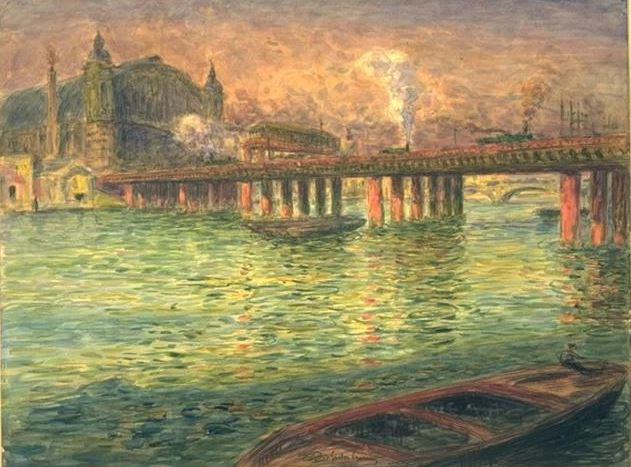
Gaston Prunier stayed in London in 1908
The Louvre holds a large watercolor titled *The Cannon Street Bridge in London*, dated precisely 1908,
This work had already been acquired by the Musée national du Luxembourg before 1910, which attests to the artist’s institutional recognition at that time.
In our painting *
*
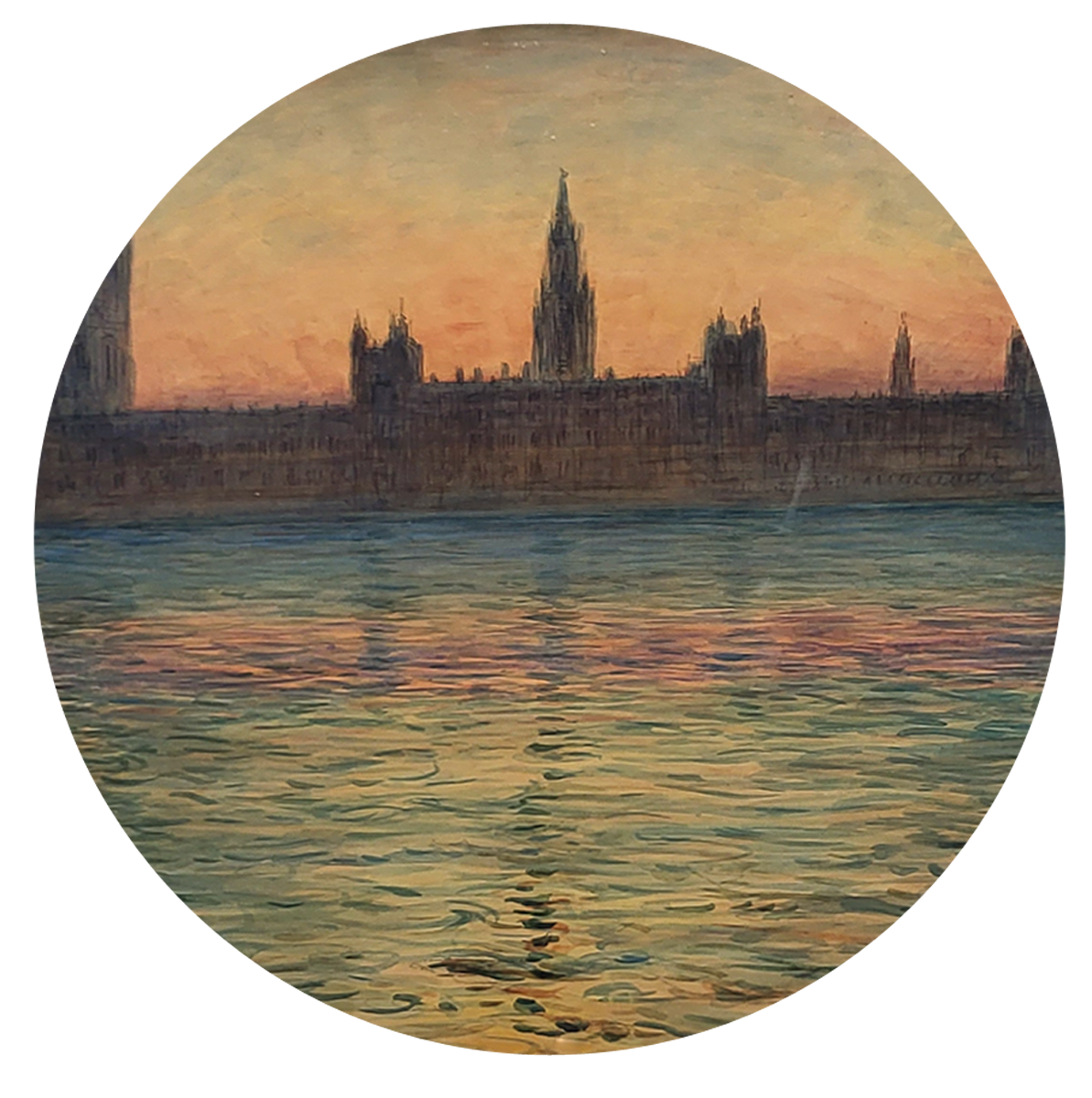
Gaston Prunier depicts one of the British capital’s most iconic landmarks: the Palace of Westminster, as seen from the opposite bank of the Thames.
But Prunier's true subject is almost as much about light as it is about architecture.
The artist devotes a large portion of the composition to the Thames.
This choice allows the river’s waters to become a vast, vibrant expanse, brought to life by horizontal, sinuous brushstrokes.
The sky is tinged with shades of pink, orange, and pale yellow, likely evoking the light of a sunset or sunrise.
These warm hues are reflected in the water and blend with the blues, greens, and turquoise of the Thames.
The contrast is particularly striking: the Parliament building appears almost backlit, rendered as a dark, monumental mass, while the sky and the river seem to dissolve into the light.
The brushstroke is free. In the water, Prunier juxtaposes small commas and long, colorful brushstrokes that fragment the reflections.
Color no longer serves merely to describe; it conveys the vibrations of light on the river’s surface.