
An oil on canvas, Syria 1918, by Edmond TAPISSIER
An oil on canvas, Syria 1918, by Edmond TAPISSIER
Prix sur demande / prices on request
Edmond TAPISSIER 1861-1943
A French artist—notably an Orientalist painter, watercolorist, illustrator, decorative painter, and cartoonist—Edmond Tapissier created a body of work at the intersection of painting and the decorative arts.
Born into a family of silk merchants in Lyon—his father was a silk merchant—he began his training under Jean-Baptiste Chatigny at the École des Beaux-Arts in Lyon. There, he learned, in particular, the techniques of large-scale decorative compositions.
He then continued his studies in Paris, first at the Académie Julian and then at the École des Beaux-Arts, under Alexandre Cabanel and Fernand Cormon.
Further information
His early career was divided between easel paintings exhibited at the Salon and the creation of large-scale decorations for religious buildings and private clients.
In 1896, he exhibited *Les Sirènes* at the Salon, a massive composition measuring 253 × 420 cm that won over critics and the public alike.
His reputation soon spread beyond France’s borders, all the way to Russia, where he received a major commission to design the interior of a restaurant in Saint Petersburg.
Tapissier realized very early on that his taste for large compositions, floral borders, cartouches, allegorical figures, and bold colors lent itself particularly well to tapestry.
Beginning in 1900, he carried out several projects for the Manufactures nationales and the Gobelins, including *Le Triomphe du Printemps* and *Une Histoire d’autrefois*, the latter of which was acquired by the government in 1907.
As early as 1906, at the Colonial Exposition in Marseille, Tapissier demonstrated his fondness for the East.
But it was especially around 1918 that this Eastern influence took on a new dimension. In 1919, he brought back numerous watercolors from a trip to Italy, Greece, and the Near East, which he had taken in the company of Charles Fouqueray and Auguste Matisse.
At the same time, he created numerous designs for the Gobelins, Aubusson, and the Manufacture de Beauvais, including *La Fontaine de Jouvence*
Tapissier also participated in the 1925 International Exhibition of Modern Decorative and Industrial Arts in Paris.
In the 1930s, he designed the pattern for the “Les Colonies” armchair for the Manufacture de Beauvais, thereby confirming the central role that decorative arts and the evocation of distant lands play in his work.
Our Work
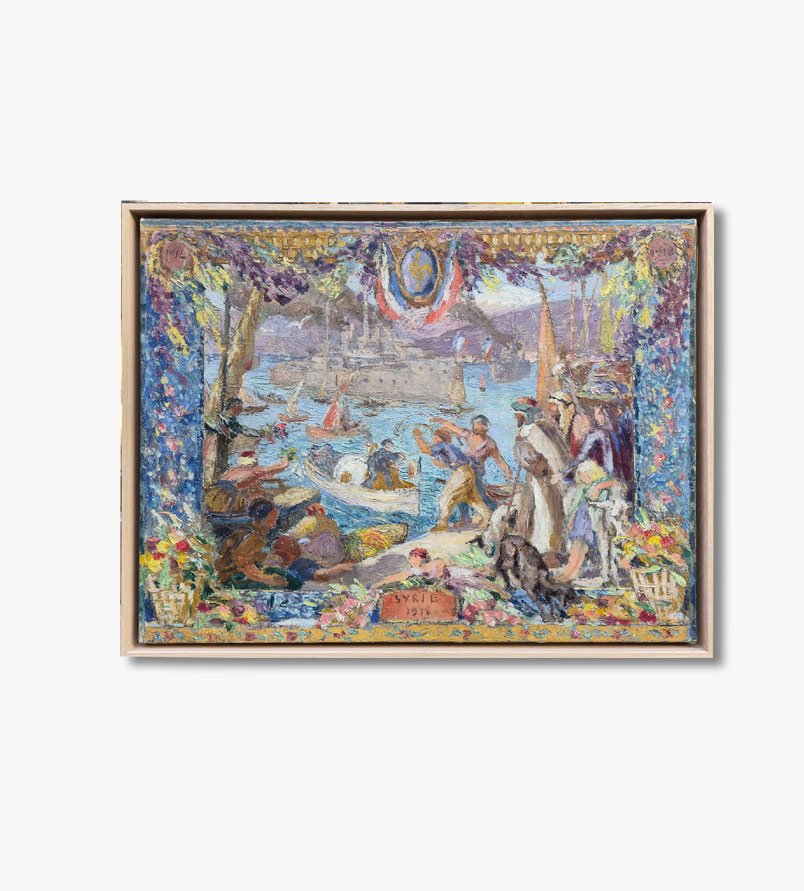
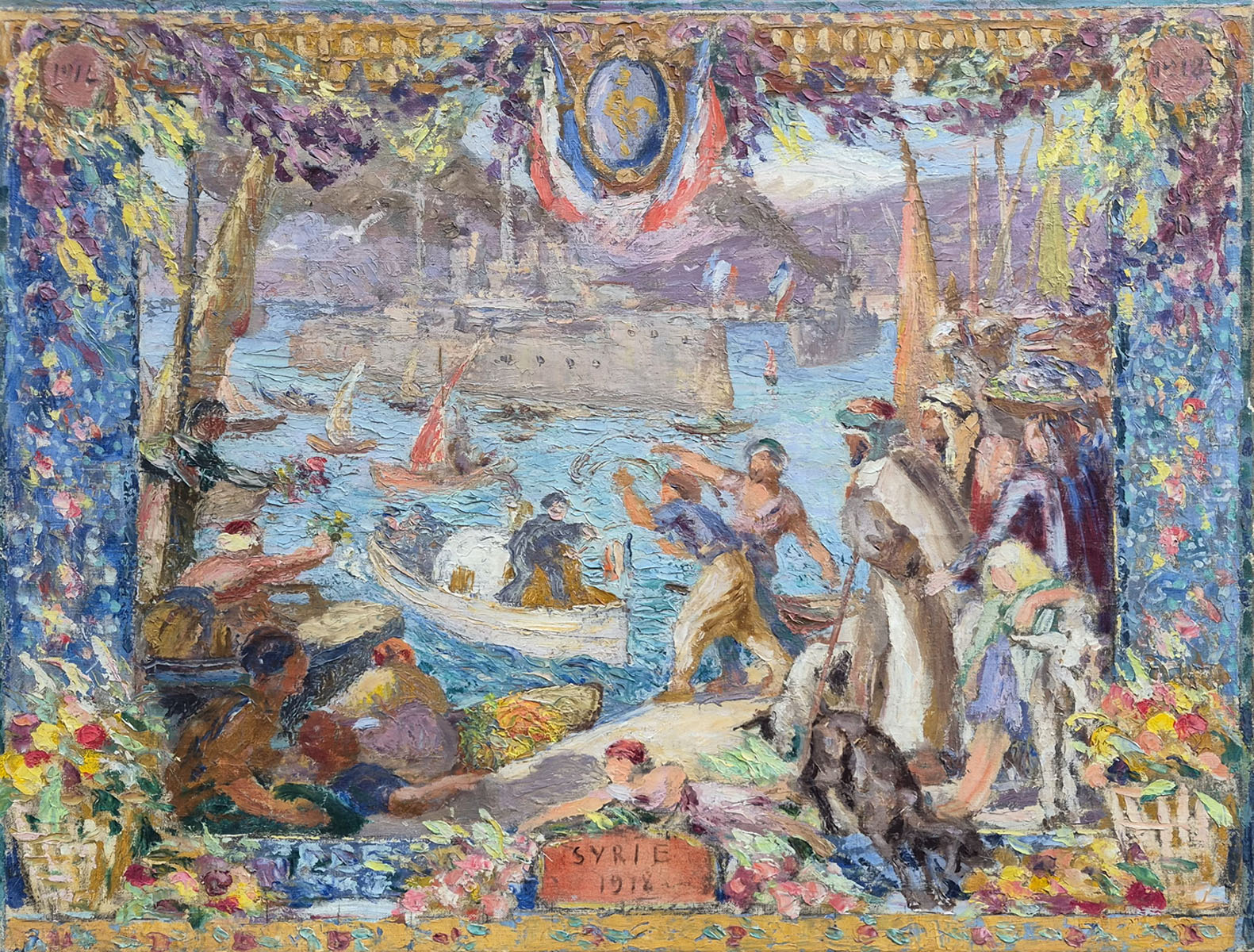
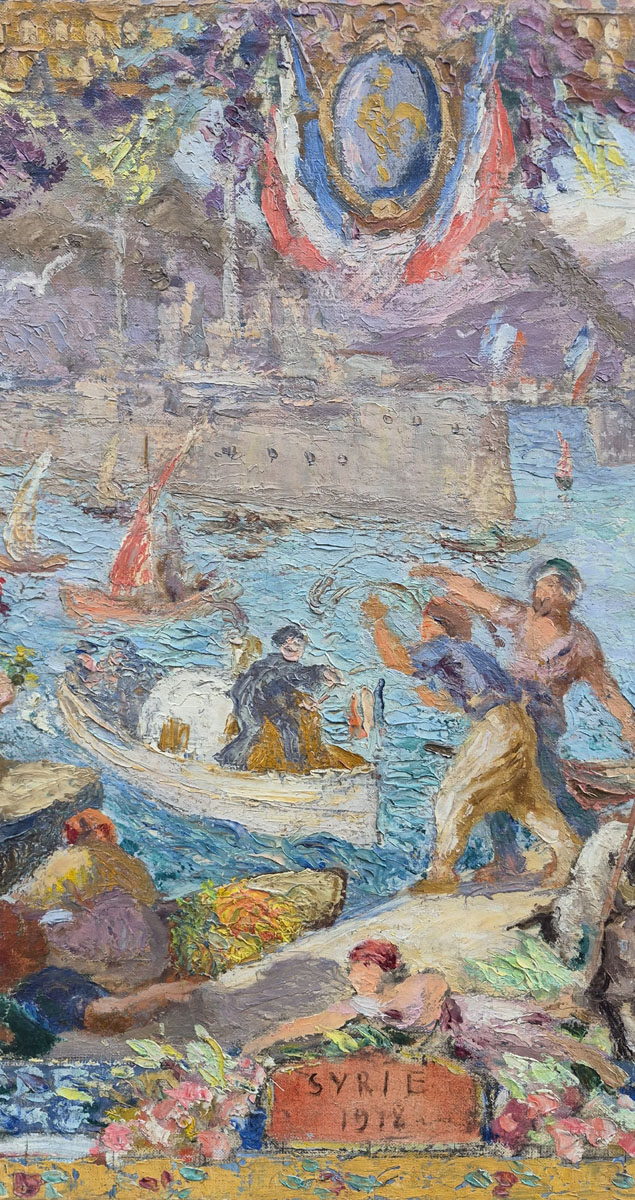
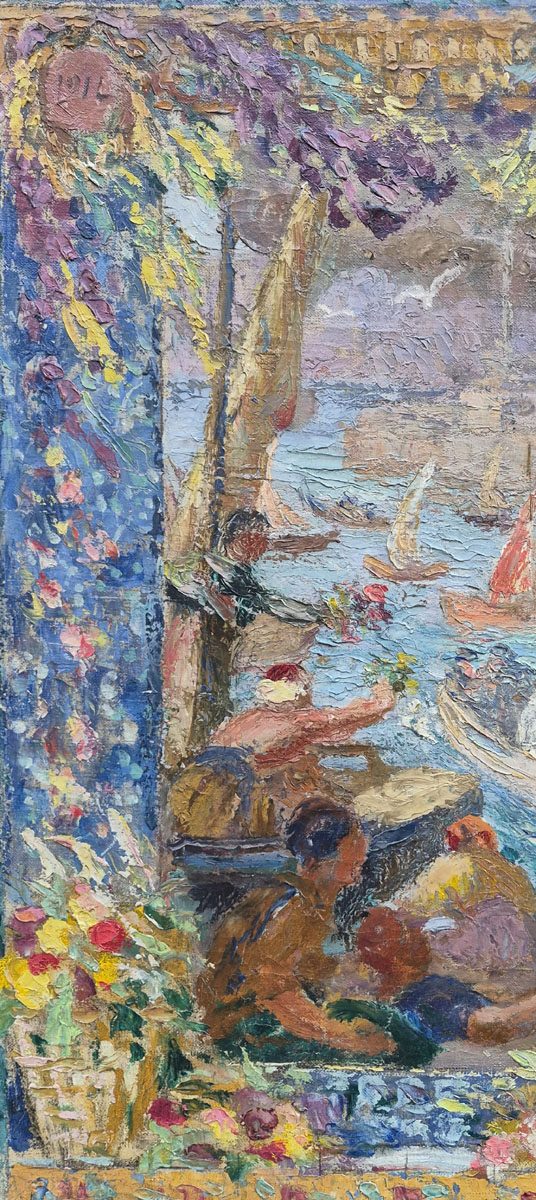
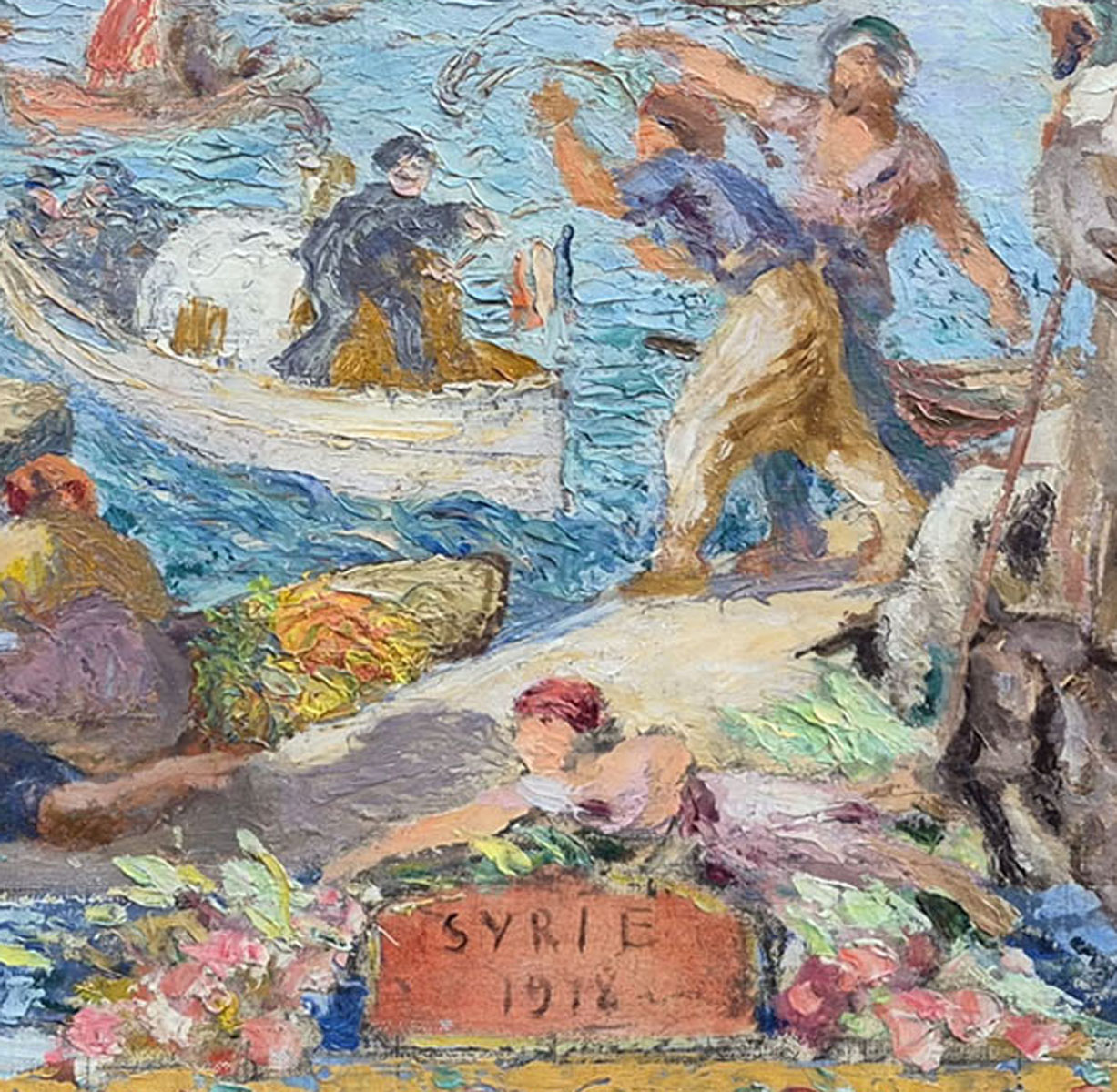
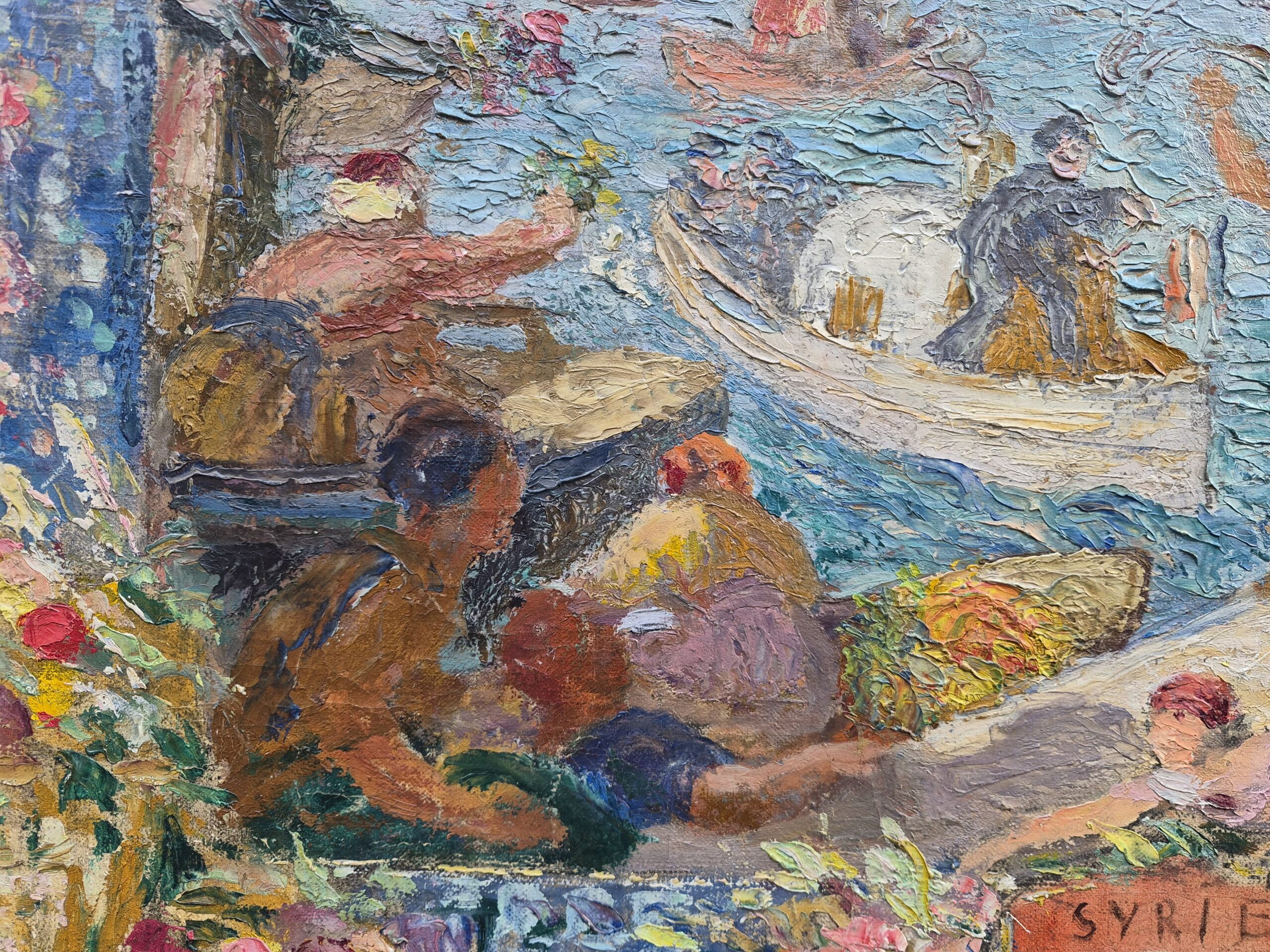
Located and dated in the center, in a cartouche: “Syria 1918.”
This date marks the end of Ottoman rule in Syria and the entry of Arab forces, led by Emir Faisal, and British forces into Damascus in the fall of 1918.
While the emir believes in the possibility of an independent state, the French and British have been negotiating behind the scenes to divide up the territories, with the French claiming the north and the coastline.
But Syria was not yet under a mandate; it would not be granted one until 1920 in San Remo.
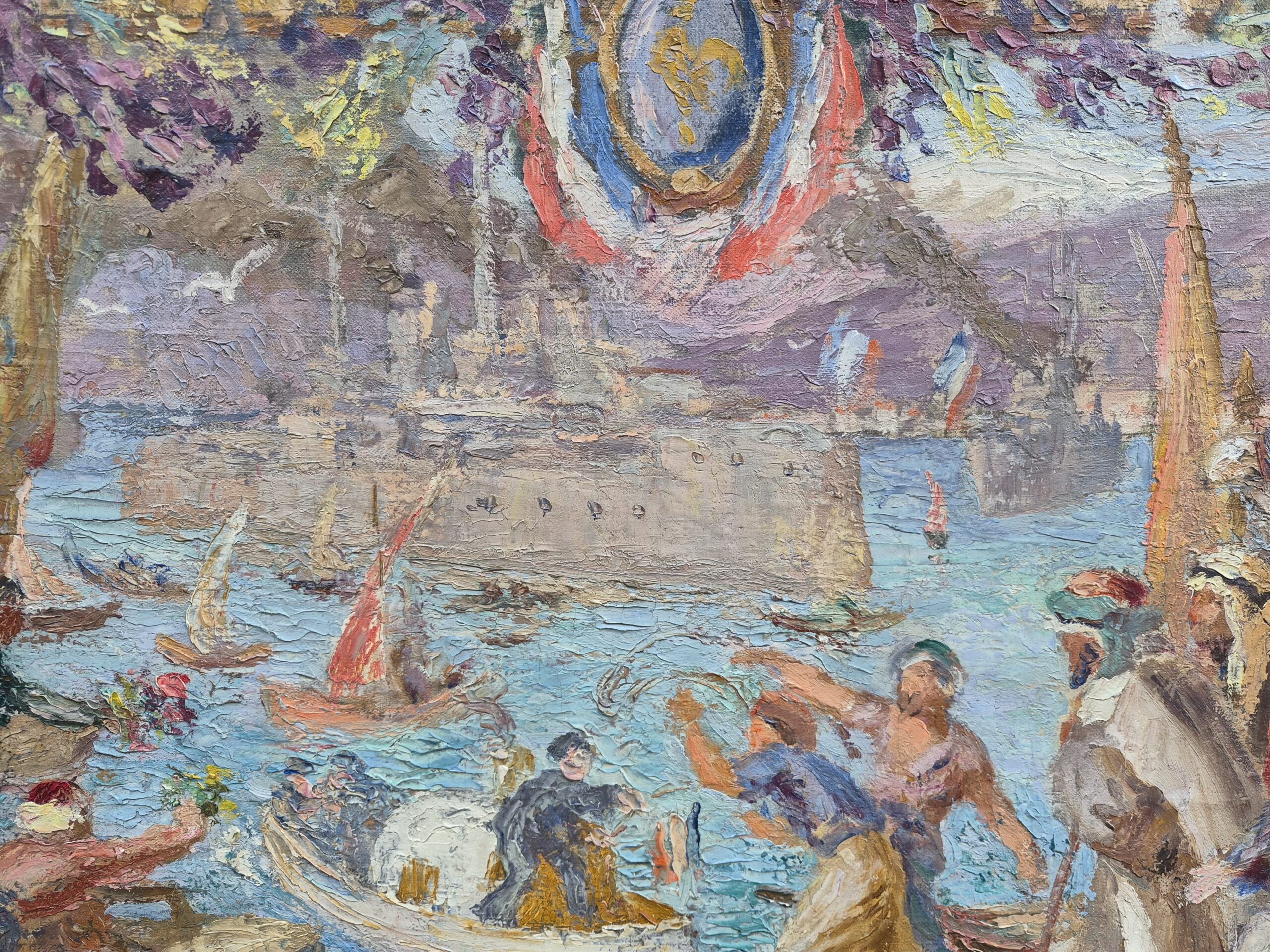
Tapissier presents here a rich and colorful composition—perhaps a sketch—of an oriental port. Perhaps it depicts one of the “Jeanne d'Arc” battleships or the “Requin” coast guard vessel.
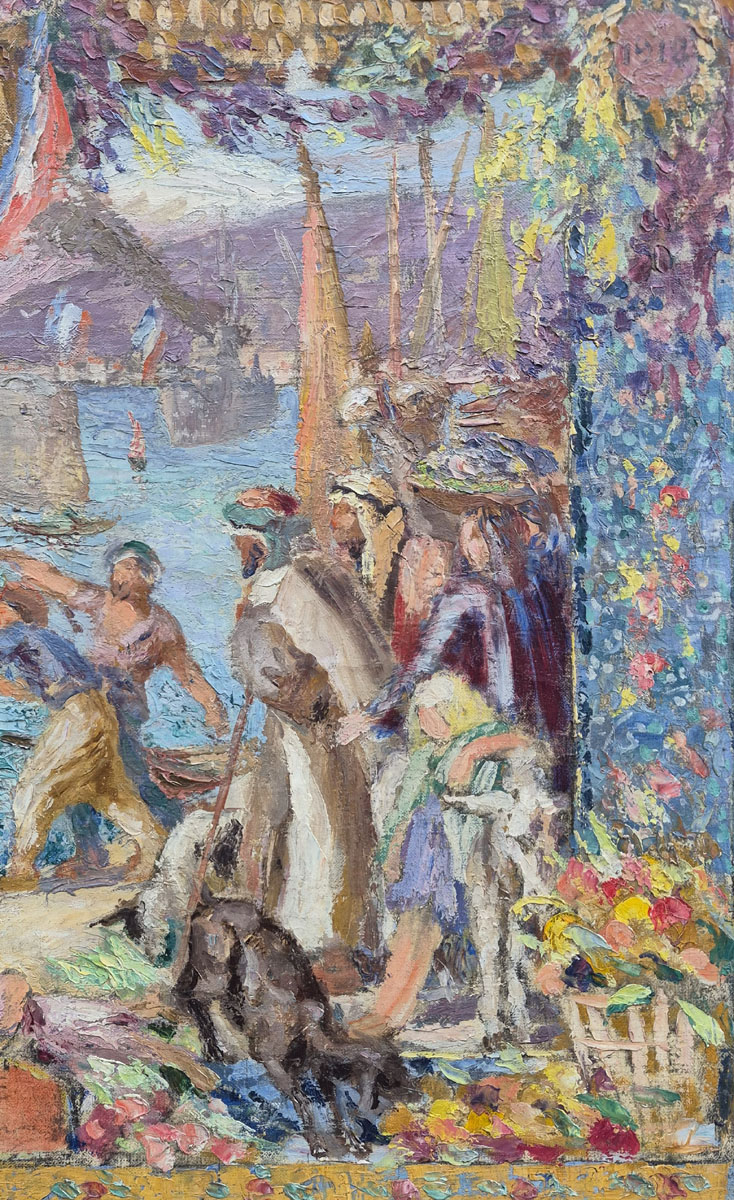
In the center, a battleship—presumably French—and sailors disembarking on the shore, greeted on the right—presumably by Arab dignitaries and women carrying baskets full of fruit; on the left, merchants and a celebrating crowd.
Above this composition is the French rooster in a medallion surrounded by the flags of the Republic, followed by a floral frieze framing the painting.
Our painting is similar to a companion piece—with “Constantinople” written in the lower cartouche—that was exhibited in 1928 and titled *Battleship in the Golden Horn*, most likely the battleship *Patrie*
Constantinople, another territory affected by the fall of the Ottoman Empire.
Another reference to a painting of the same kind can be found in the June 1921 issue of *Le Mercure de France*: “Mr. Tapissier presents the battleship *Patrie* anchored in the harbor of Corfu”—perhaps another painting?
We can therefore hypothesize that this was a decorative project for tapestries depicting France’s territorial upheavals and victories in the East during this period.