Oil on canvas, *The Painter’s Studio* by Louis VAN ENGELEN
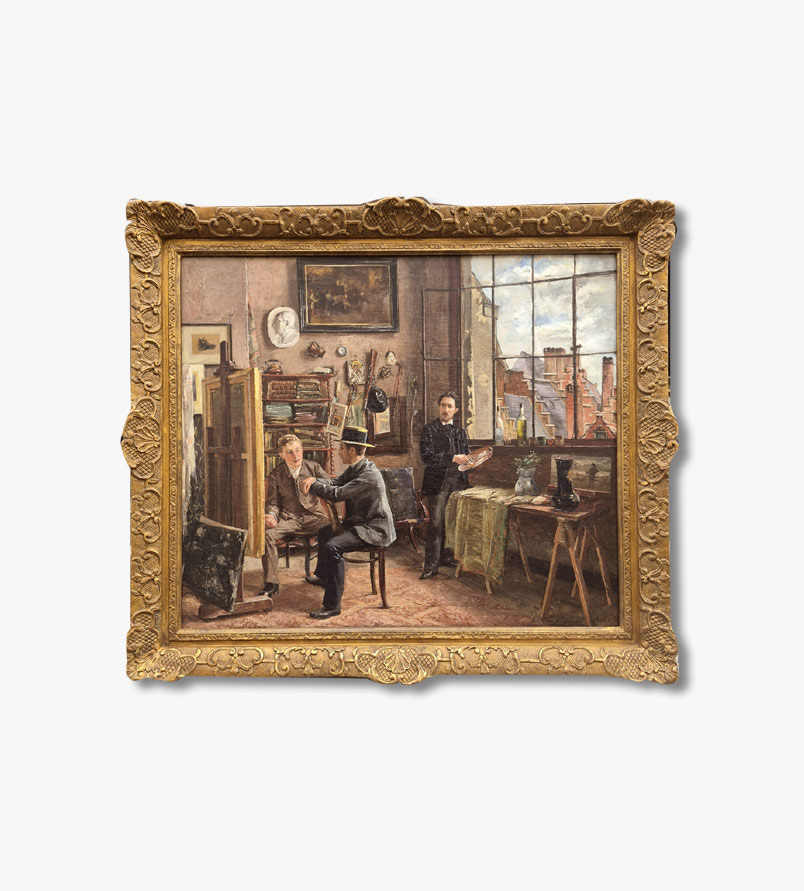
Oil on canvas, *The Painter’s Studio* by Louis VAN ENGELEN
Prix sur demande / prices on request
Louis van Engelen 1856–1944
Born in Lier, Belgium, he established himself as one of the most remarkable realist painters of his time.
He became a member of influential artistic circles in Antwerp, such as “Als ik Kan” and “Les XIII,”
and regularly exhibited his paintings at art shows in Belgium and abroad, receiving awards and honorable mentions that highlighted the quality and finesse of his work.
Further information
| Dimensions | 78 × 69 cm |
|---|
From a very young age, he showed a talent for drawing and painting, which led him to enroll in the art school in his hometown before continuing his studies at the Royal Academy of Fine Arts in Antwerp, where he studied under Charles Verlat, a renowned master of Belgian realism. This solid academic training enabled him to develop a perfect mastery of drawing, perspective, and composition, as well as a particular sensitivity to the play of light and textures.
Van Engelen received several awards in 1876,
including a second prize for excellence in drawing,
a first prize for historical composition,
as well as other awards in perspective, anatomy, and costume,
demonstrating his great technical mastery from the very beginning.
Although Van Engelen did not win the Belgian Prix de Rome in 1880 despite a remarkable performance (he received the highest score in historical composition during the preliminary round), his technique and artistic vision earned him the respect of his peers and growing recognition in Belgian and international artistic circles
In the early 1880s, Van Engelen began his professional career by collaborating with Verlat on the creation of large-scale historical panoramas, such as the Battle of Waterloo in Brussels in 1882 and the Moscow Panorama, for which he traveled to Russia with Verlat and other artist colleagues.
These ambitious projects allowed him to gain valuable experience, work on a large scale, and refine his realistic vision.
Shortly after his stay in Russia, Van Engelen embarked on a trip to Italy in 1883, where he discovered Mediterranean art and light, an influence he gradually incorporated into his palette. In the years that followed, he also traveled regularly:
he visited the United States in the early 1890s, where he painted and exhibited some of his works,
then in 1898 to the Belgian Congo, where he created landscapes inspired by the colonial lands
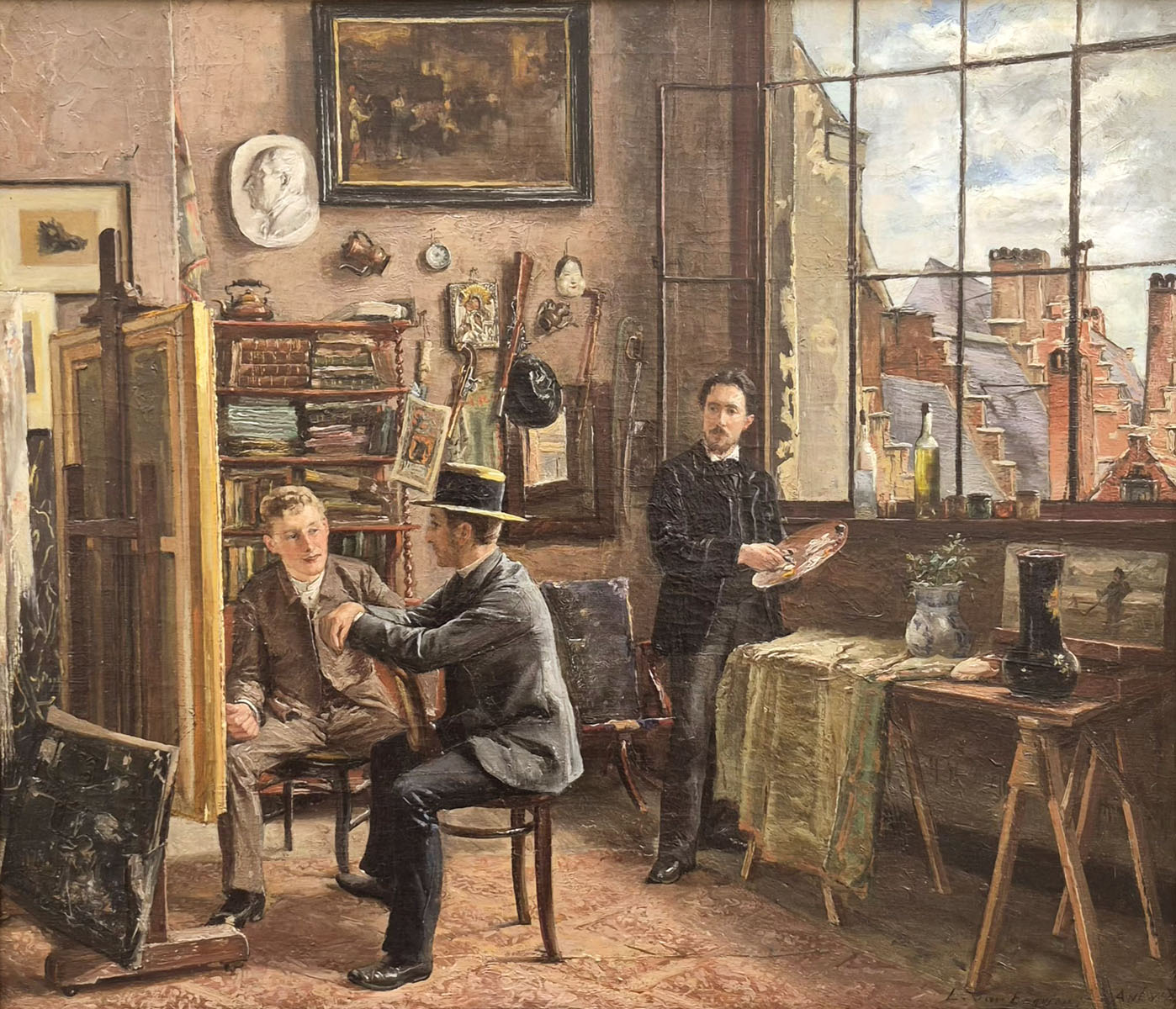
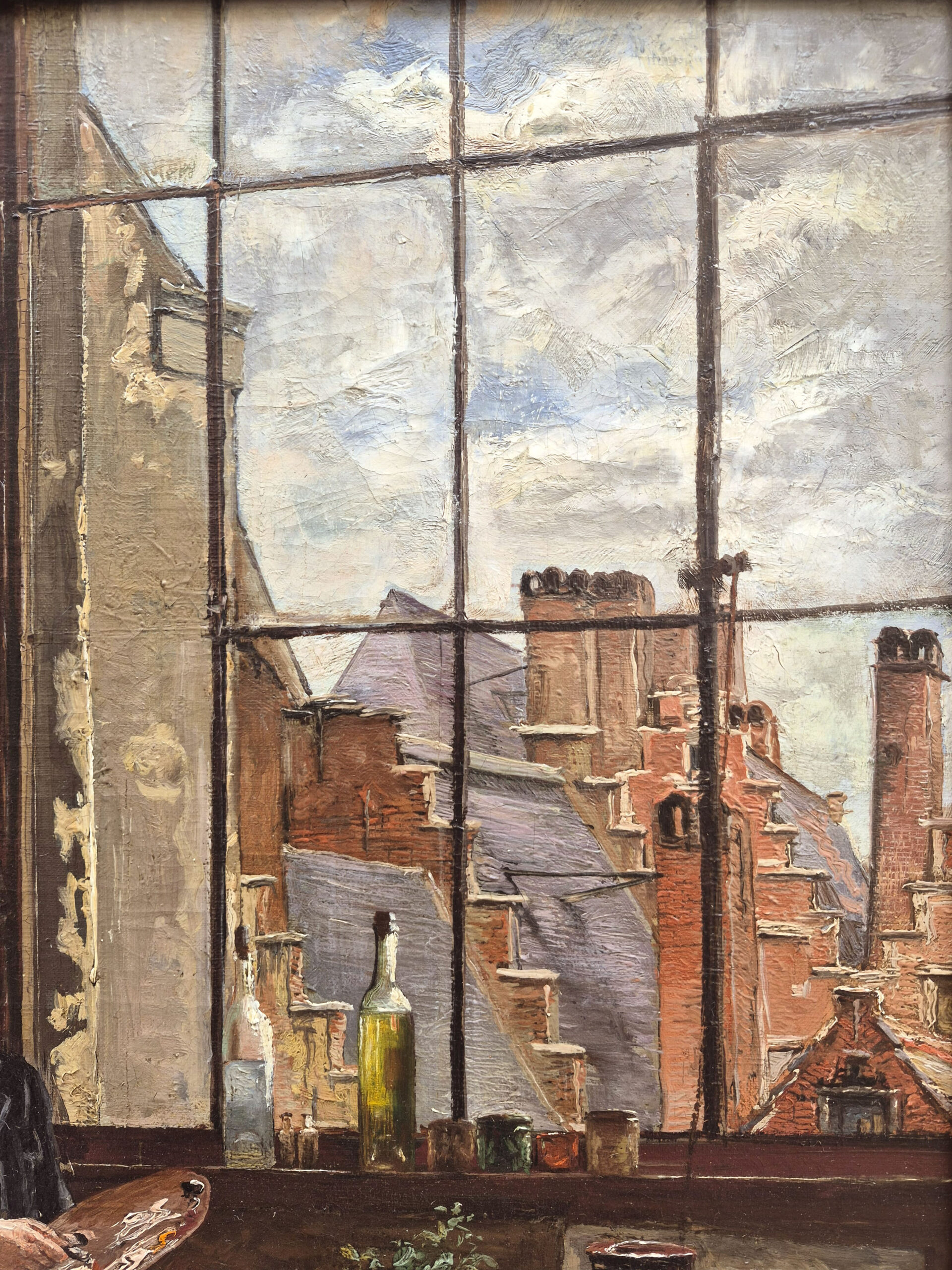
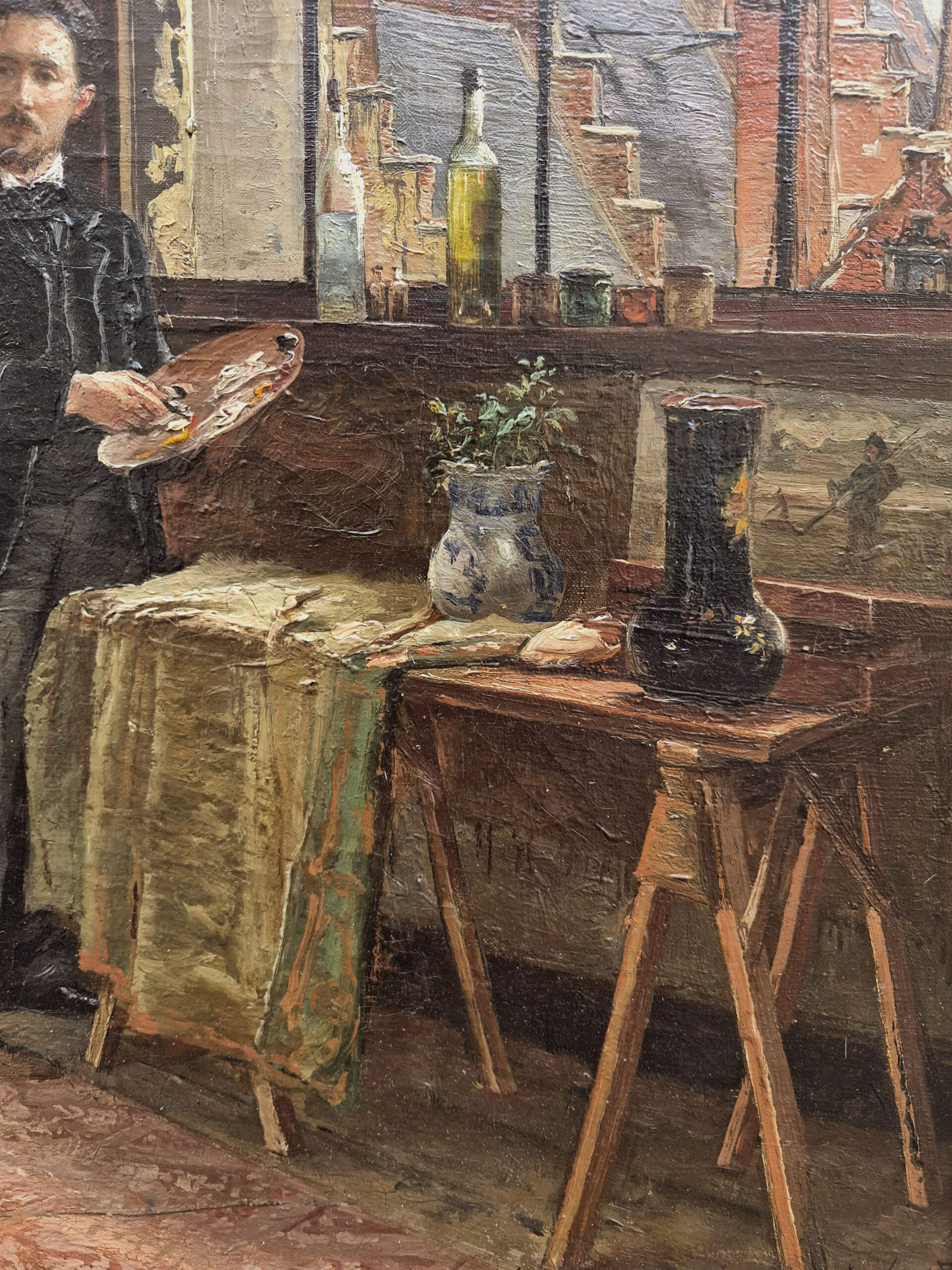
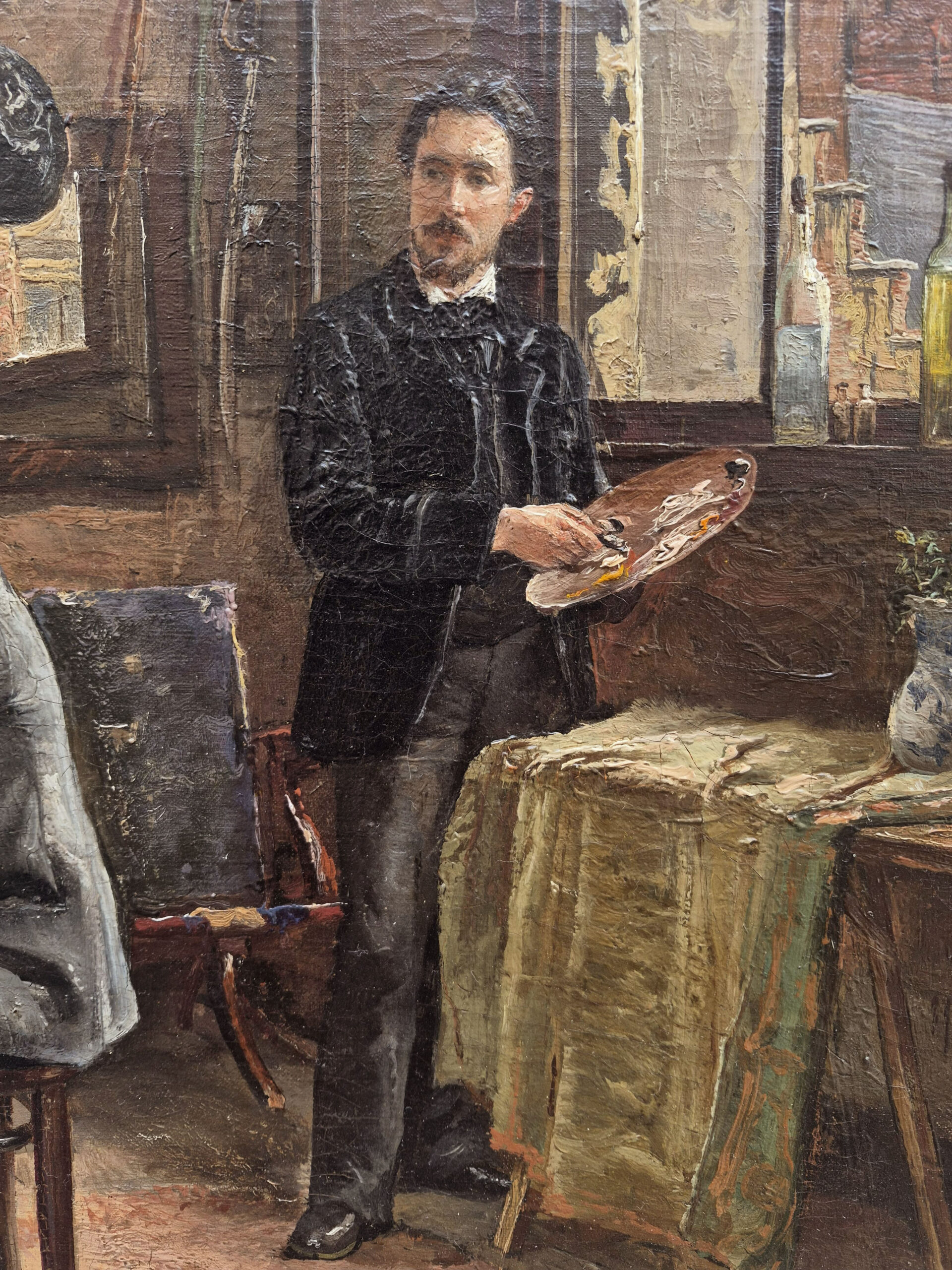
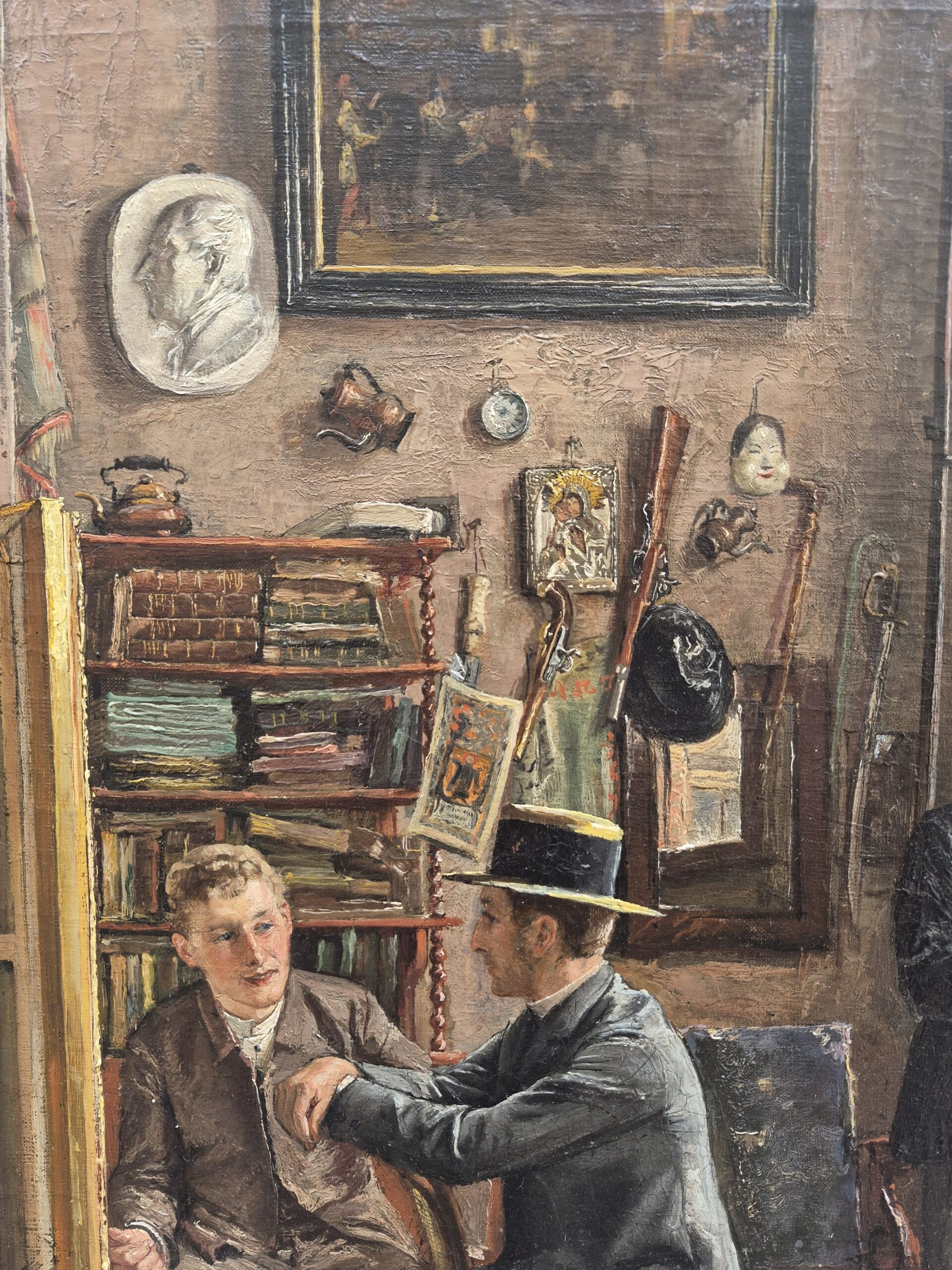
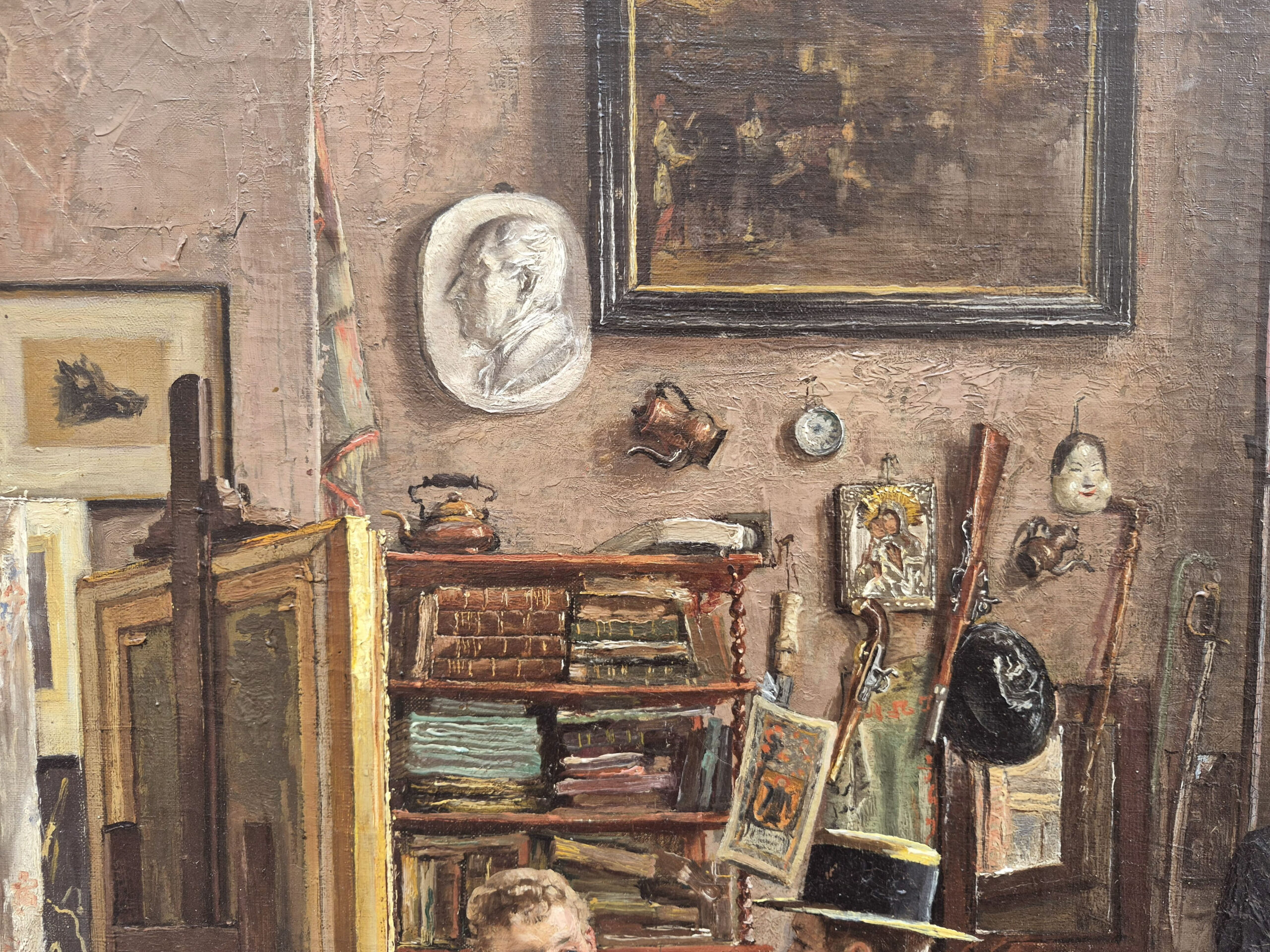
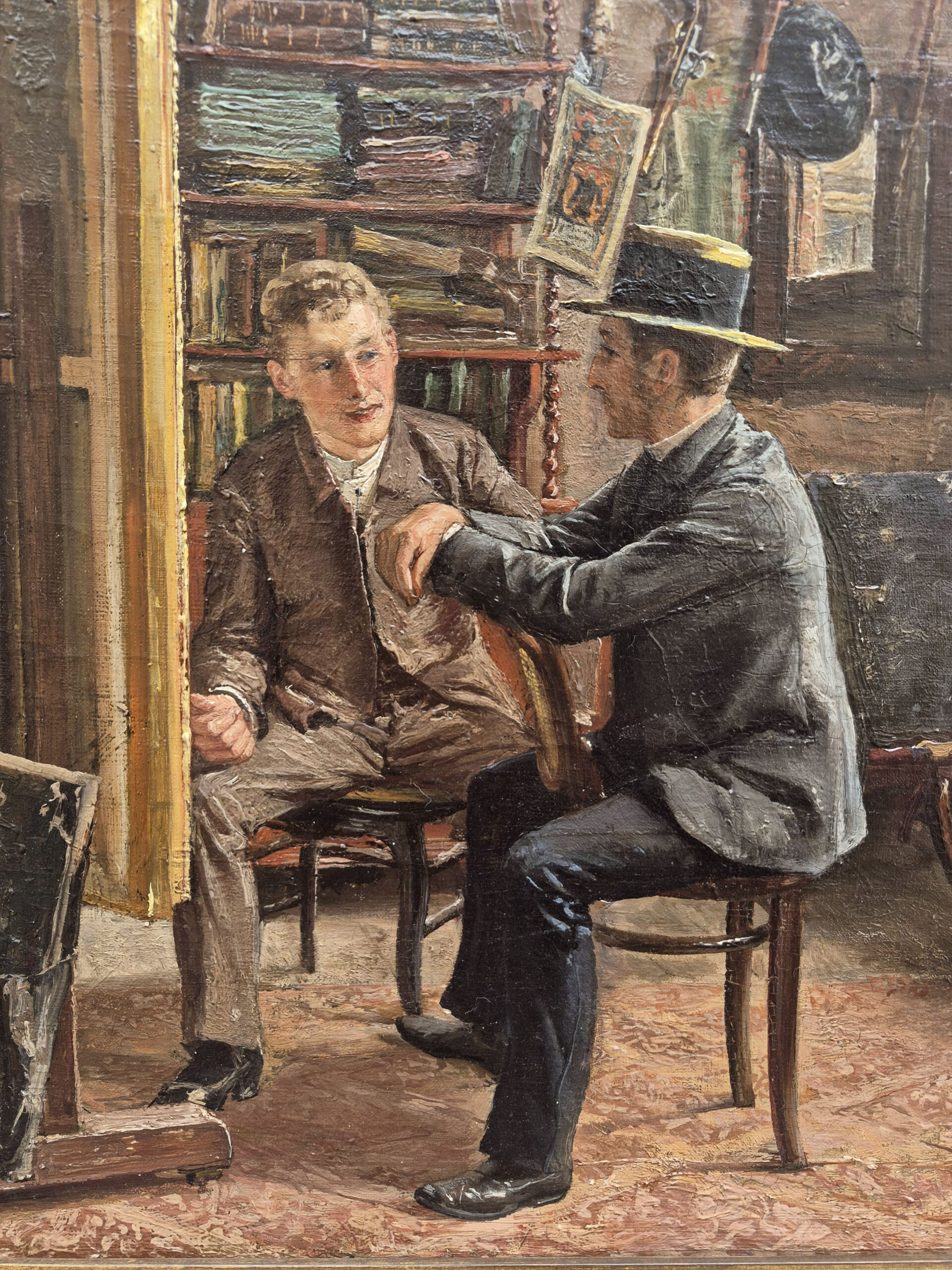
The painting likely depicts Louis van Engelen’s studio in Antwerp.
At the center of the composition, three figures bring the scene to life.
The figure near the large window, turned slightly inward, immediately catches the eye: his posture and demeanor suggest that he is observing Van Engelen’s work or contemplating a piece, while natural light gently illuminates his face and clothing.
This play of light, filtered through the windows, lends the scene an almost photographic realism and underscores the studious tranquility of the studio.
On the right, we can see Van Engelen himself, holding his palette and brushes, focused on his canvas, while the space around him is filled with references to artistic life: study frames, plaster sculptures, books, and various painting tools all attest to a lively and thoughtful studio. The precision of the objects and the way the light caresses them demonstrate Van Engelen’s keen eye and attention to detail.
It is possible that the other two figures, who are more discreetly positioned in the background, are members of Les XIII, an artists’ circle founded in Antwerp in 1891 to which Van Engelen belonged.
Their implied presence adds a social and collaborative dimension to the scene: the studio becomes not only an artist’s workplace but also a space for dialogue and creative exchange among painters.
The composition, lighting, and meticulous details make this painting a true snapshot of artistic life in Antwerp at the end of the 19th century, where one can almost feel the light streaming through the window, hear the studious silence of the studio, and observe the artists’ focused movements as they work. This
painting is a tribute to the artistic practice, meticulous realism, and community of painters of that era