
An oil painting on wood, *The Mouse* by Giacomo FAVRETTO
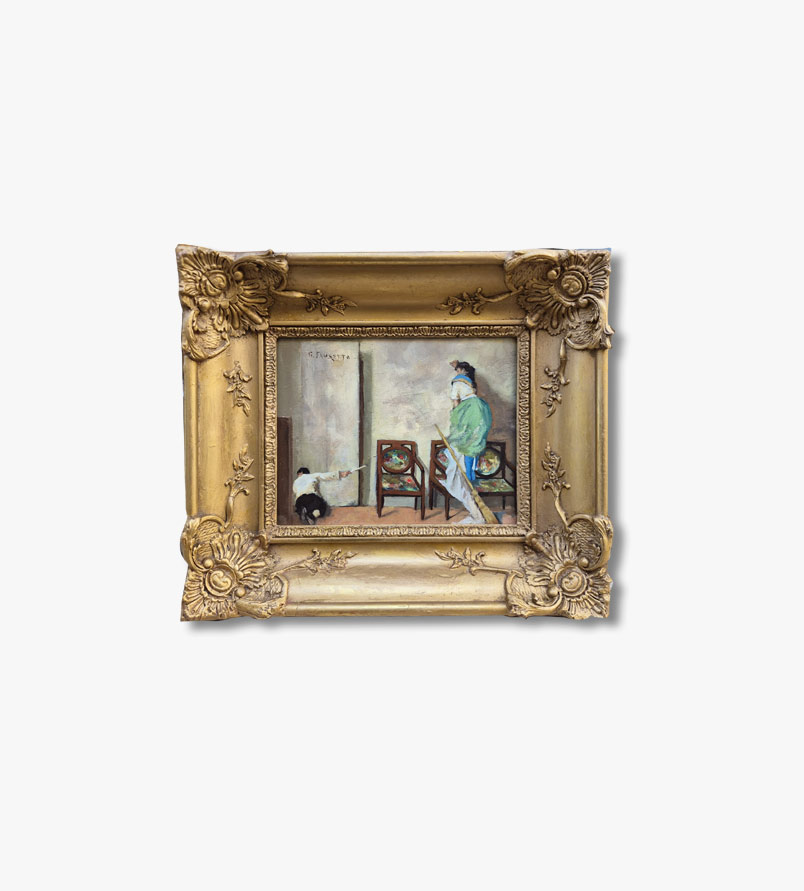
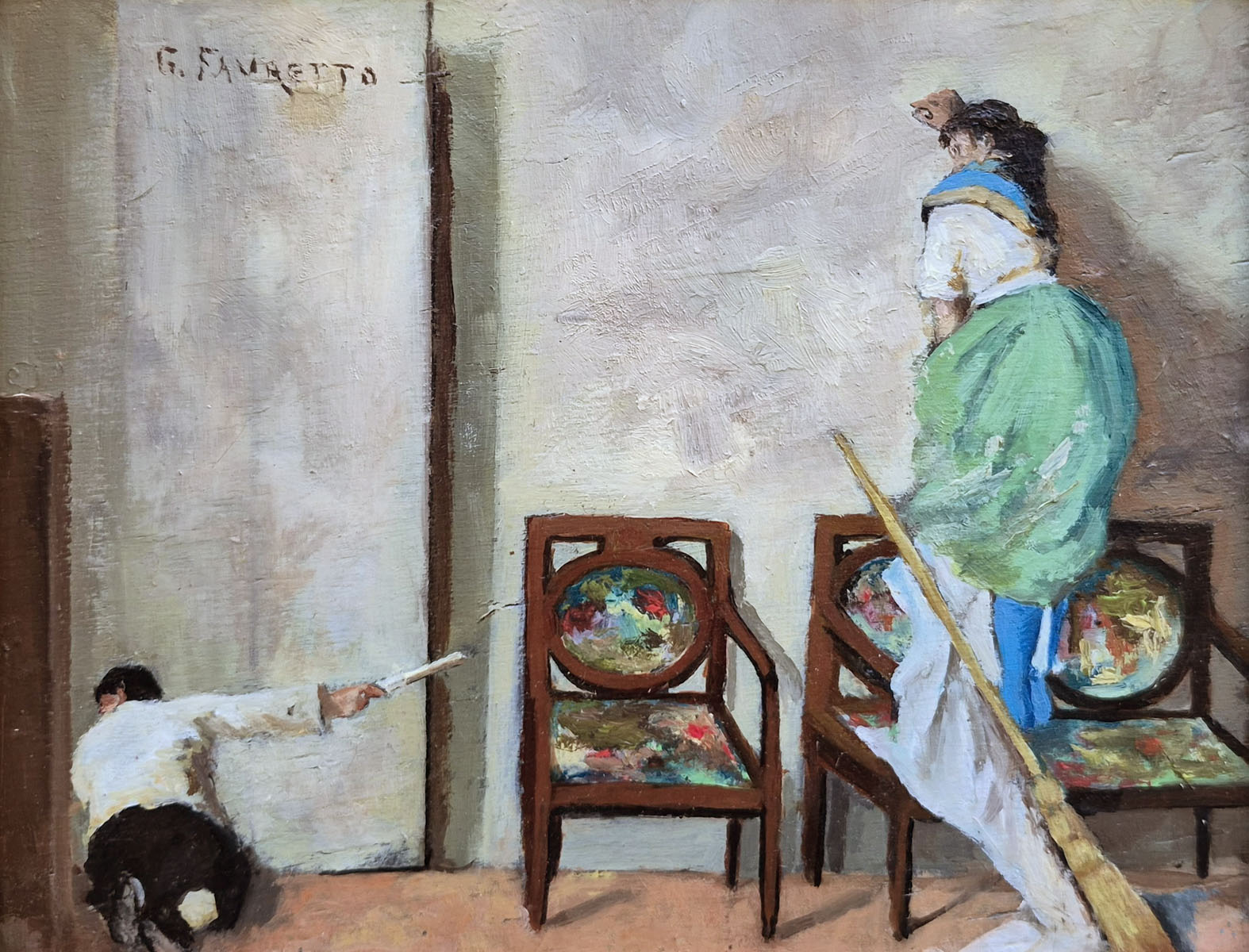
An oil painting on wood, *The Mouse* by Giacomo FAVRETTO
Prix sur demande / prices on request
Giacomo FAVRETTO 1849–1887
Giacomo Favretto is one of the great painters who revitalized 19th-century Venetian painting. Blending the realism of modern life with traditions stemming from the great colorists of the 18th century, he leaves us a marvelous kaleidoscope of the Venice of his time.
The son of a carpenter, he naturally began working in his father’s workshop at a very young age. His talent for drawing was quickly noticed by Count Antonio Zanetti, whose palace was located nearby. The count introduced him to his circle, and as a result, the young man received lessons from painters close to the count.
He then enrolled at the Academy of Venice in 1864. There, the young Favretto studied under many great Venetian masters, who provided him with a solid classical education and, above all, an openness to modernity and a keen eye for depicting his everyday life.
The young man is moving away from tradition and large-scale historical paintings. He prefers smaller formats—scenes of the street, the studio, and his immediate surroundings.
These themes are part of “verismo,” a new trend toward realism.
Further information
| Dimensions | 28 × 24 cm |
|---|
In 1873, it was with *The Anatomy Lesson* that he caught the attention of critics and collectors: a contemporary subject, devoid of idealization. A rigorous composition, yet executed with a brushstroke free from academic constraints.
From that point on, the young artist sought to capture a certain atmosphere.
Despite his illness and the loss of an eye, Favretto painted tirelessly and participated in the 1878 World’s Fair in Paris.
In 1880, he presented a political work denouncing the abusive restoration practices carried out on old paintings by the great masters. *Vandalismo! Poveri antichi* won the Principe Umberto Prize.
From that point on, the artist devoted himself to depicting Venetian life, infusing his paintings with an intense color palette rarely matched by his contemporaries. His figures, rendered with complete spontaneity, nonetheless reveal a thorough study.
By reinventing the way he depicted his subjects, Favretto continued to capture the attention of all the major Italian collectors until his untimely death at the age of 37.
In 1899, the Venice Biennale dedicated a retrospective to him, underscoring the importance of his legacy for painters of the next generation.
His work was also the subject of a major retrospective exhibition, *Giacomo Favretto (1849–1887). Venice: Charm and Seduction*, which was presented in Rome and then at the Correr Museum in Venice in 2010–2011.
The Mouse
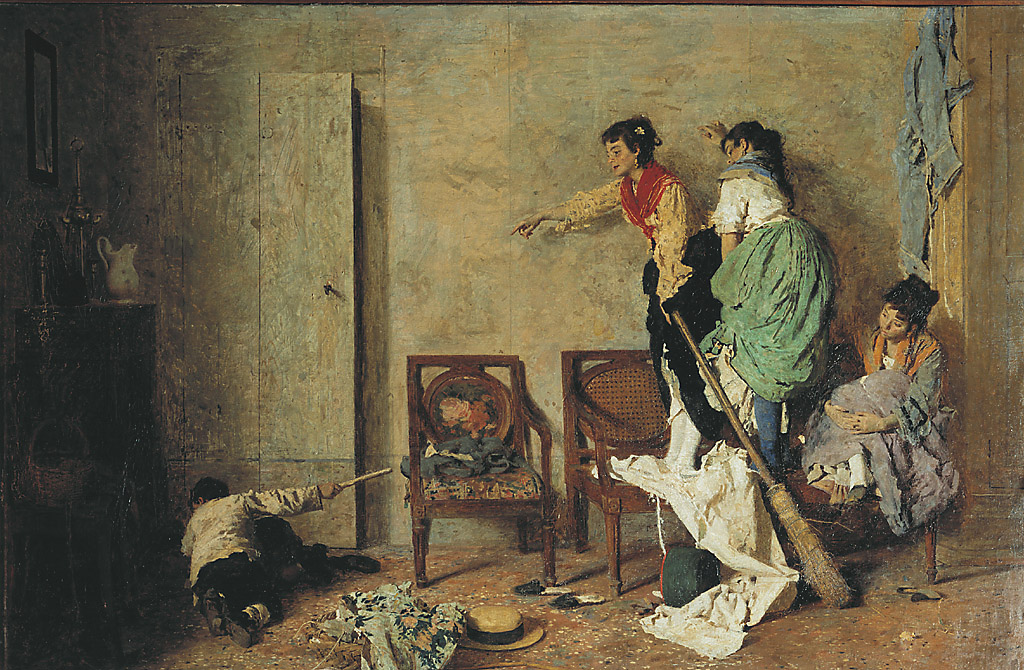
In 1878, Favretto exhibited *La Souris*, which is now housed at the Pinacoteca di Brera in Milan.
The work surprised viewers of the time in more ways than one. First, because of its size—a very large 59 × 90 cm, dimensions usually reserved for historical depictions—yet here, Favretto depicts, in a tragicomic manner, a mouse’s fear.
Our painting is one of his accomplished studies.
In the original version, three terrified women standing on chairs point out the animal's location to a young boy who is kneeling.
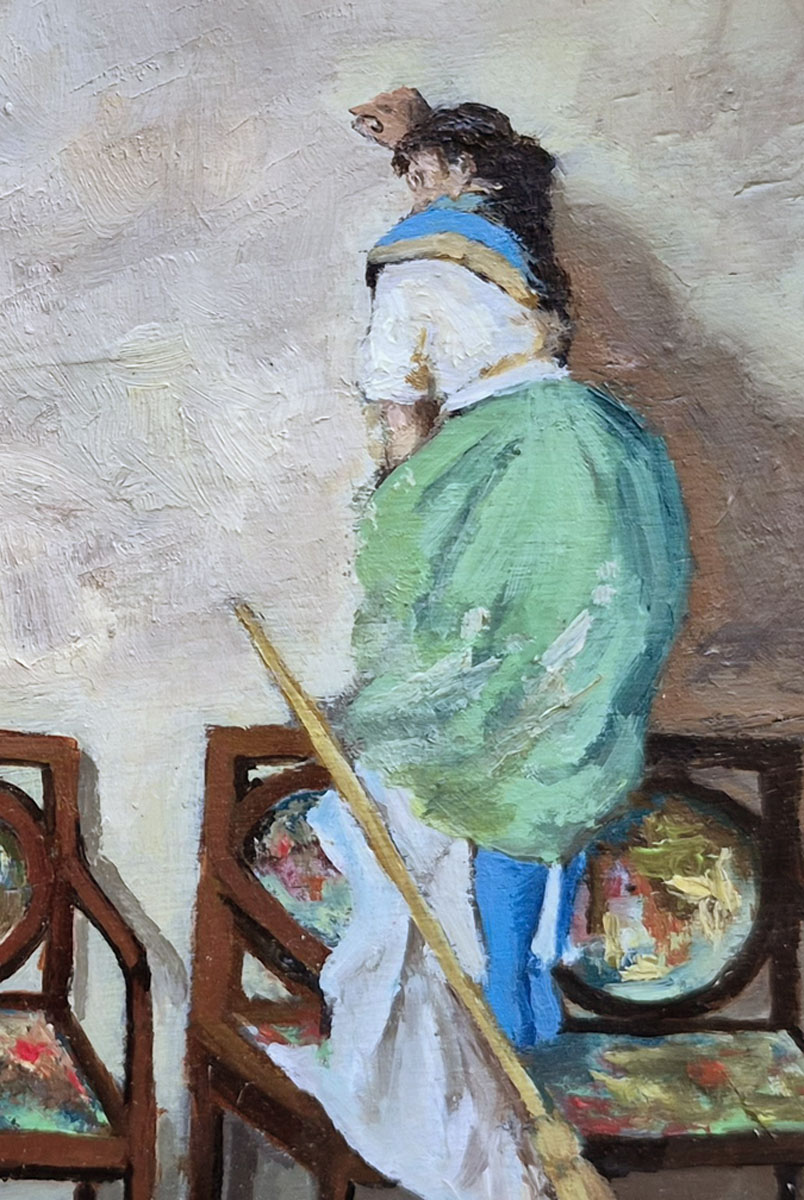
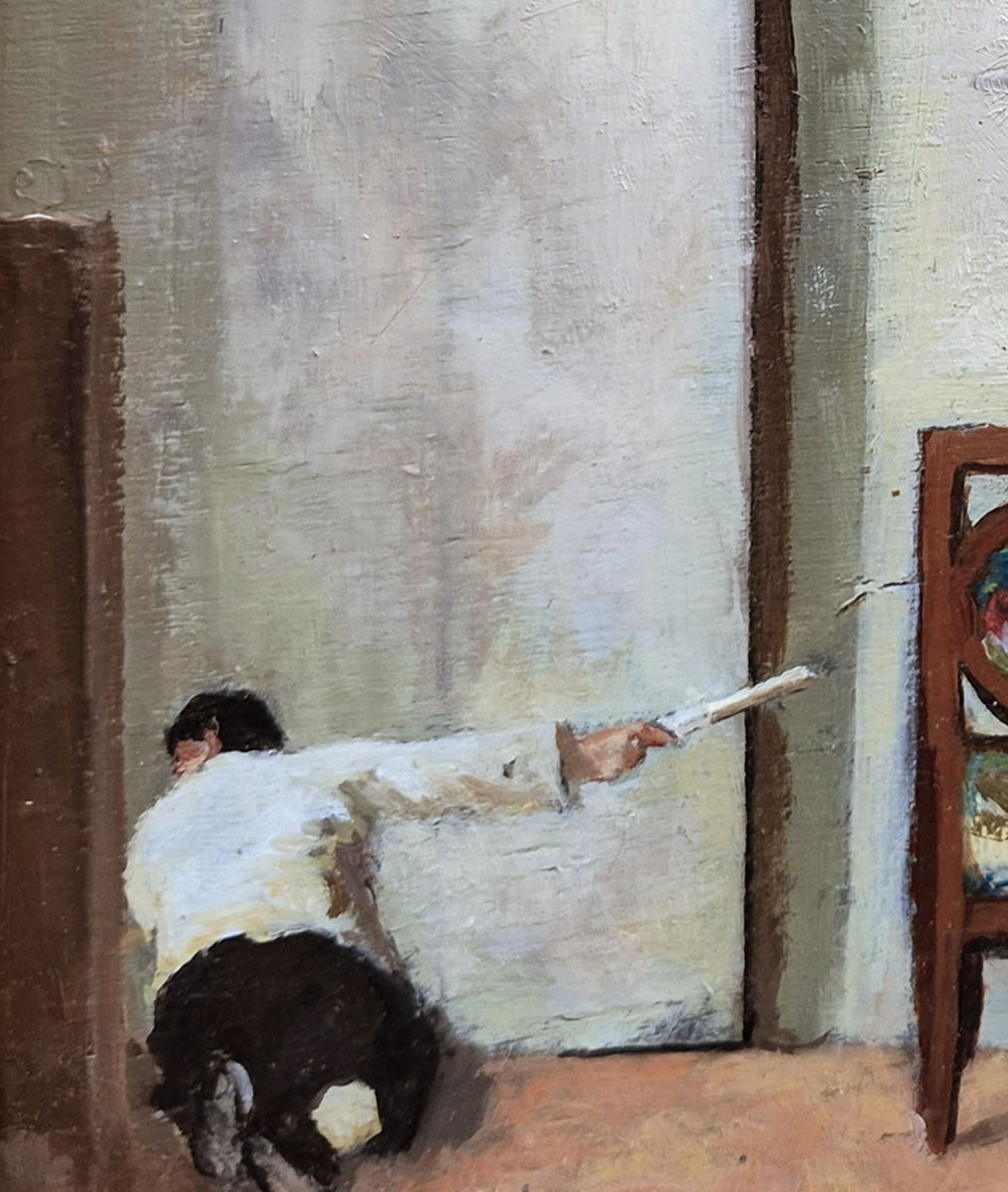
In our version, which is smaller and more sketchy, the only figures depicted are the young woman in the green dress, seen from behind, and the young man.
The accuracy of his depictions and the vibrancy of his colors contributed to the painter's success.